
For most of human history, logistics has been constrained by geography.
Ships connected continents. Railways connected interiors. Aircraft compressed time. Containers transformed global trade by standardising how cargo moved between factories, ports, vessels and markets.
Now another transport network is beginning to emerge—one that does not end at a port, airport or national border.
It ends in orbit.
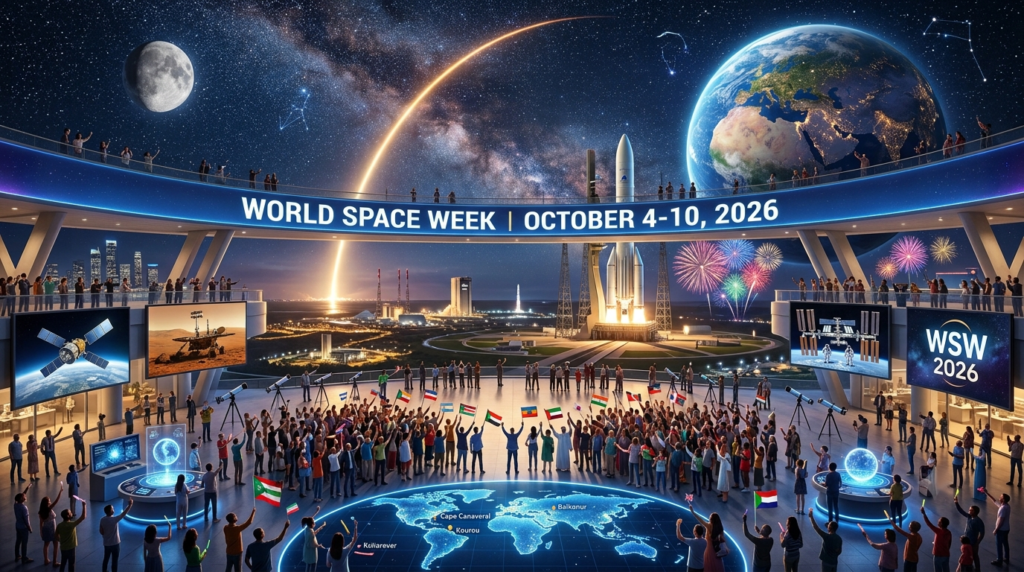
As we mark World Space Week, the idea of space as a logistics network is becoming increasingly relevant. Reusable rockets, falling launch costs, satellite constellations and experiments in orbital manufacturing are turning what was once almost exclusively a government-led scientific endeavour into something that increasingly resembles a commercial supply chain—with cargo, routes, schedules, infrastructure and delivery economics.
For logistics professionals, that raises a fascinating possibility.
Could space become the next layer of the global supply chain?
And if it does, the winners may not simply be the countries capable of reaching orbit. They could be those that make moving cargo to—and eventually from—space reliable enough to become routine.
From $54,000 to $2,000 Per Kilogram: The Economics Changing Space
Every logistics revolution begins with economics.
During the Space Shuttle era, the source estimates that putting one kilogram into low Earth orbit cost approximately $54,000. By 2026, it puts the comparable cost using a reused Falcon 9 at approximately $1,500–$2,700 per kilogram.
The source also notes the much more ambitious target associated with Starship: potentially bringing launch costs below $100 per kilogram if its long-term objectives are achieved.
Whether that target is ultimately reached—and when—is uncertain.
But the direction matters.
Because logistics history tells us what happens when the cost of moving something falls dramatically.
Entirely new markets appear.
Reusable Rockets Could Do to Space What Containers Did to Ocean Freight
Before containerisation, international shipping was expensive, labour-intensive and painfully slow.
Cargo had to be individually loaded and unloaded. Standardisation changed the equation.
The container did not simply make existing trade cheaper.
It made new patterns of global trade economically possible.
Factories could be located differently. Supply chains could stretch across continents. Manufacturing could specialise. Ports could automate. International trade could scale.
Reusable rockets could have a similar effect on the orbital economy.
The uploaded analysis makes precisely this comparison: reusable rockets are beginning to do to space what standardised containers did to ocean freight—reducing the cost of moving mass enough that previously unrealistic ideas can become commercial calculations.
That is a logistics story.
Once transportation becomes sufficiently affordable and repeatable, the question changes from:
“Can we send this to space?”
to:
“Does the economics justify sending this to space?”
That is an enormous shift.
Space Is Beginning to Develop Its Own Logistics Network
Look beyond the rocket itself and the parallels with terrestrial freight become increasingly clear.
Every functioning logistics network requires infrastructure.
Ocean freight needs ports, terminals, container yards and hinterland connections.
Air freight needs airports, cargo terminals, ground handlers and warehousing.
Space logistics requires launch sites, rockets, tracking networks, ground stations, re-entry infrastructure and ultimately facilities capable of handling cargo moving in both directions.
And just like ocean or air freight, capacity matters.
A theoretically cheap launch is of little commercial value if there is no launch slot available when a customer needs it.
Reliability matters.
Schedules matter.
Payload restrictions matter.
Regulatory clearance matters.
The rocket may be spectacular.
The underlying challenge is surprisingly familiar to anyone working in freight forwarding:
Can the cargo move where it needs to go, when it needs to go, at a commercially viable cost?
The Ukraine War Revealed Another Side of Space Infrastructure
The commercial opportunity cannot be separated entirely from geopolitics.
The uploaded analysis points to Ukraine as one of the clearest demonstrations of how strategically important orbital infrastructure has become.
After conventional communications infrastructure was severely disrupted following Russia’s 2022 invasion, Starlink terminals became an important communications layer for Ukraine, connecting units, command centres and other operations. The source also describes the subsequent reported use of Starlink terminals obtained through unofficial channels by Russian forces.
For logistics and supply-chain strategists, there is a broader lesson here.
Critical infrastructure creates dependency.
A country dependent on another country’s port faces vulnerability.
A manufacturer dependent on one supplier faces vulnerability.
A business dependent on one shipping corridor faces vulnerability.
And a nation dependent on privately or foreign-controlled orbital infrastructure can face the same problem.
Space may be new.
The supply-chain principle is not.
Space Infrastructure Is Becoming Dual-Use Infrastructure
A communications constellation can connect remote communities.
It can also support military communications.
A reusable rocket can launch commercial satellites.
It can also launch strategic payloads.
A re-entry vehicle designed for commercial purposes may also generate valuable data for defence applications.
The uploaded analysis therefore argues that commercial and strategic space infrastructure are becoming increasingly intertwined.
This has major implications for future trade.
As governments begin treating launch capacity, satellite networks and spaceports as strategic infrastructure, the orbital economy may start resembling other strategically important sectors such as semiconductors, energy and telecommunications.
Countries may increasingly ask not only:
“What is the cheapest provider?”
but also:
“Whose infrastructure can we afford to depend on?”
That is precisely the calculation businesses have been making across global supply chains since the pandemic.
The Next Manufacturing Hub Could Be 400 Kilometres Above Earth
Perhaps the most fascinating development is not what humans are sending into space.
It is what may eventually come back.
For almost the entire history of logistics, manufacturing has happened on Earth.
Raw materials arrive at a factory. Products are manufactured. Finished goods enter a distribution network.
Orbital manufacturing reverses part of that model.
Raw materials or precursor materials travel upward.
Manufacturing occurs in microgravity.
High-value finished products return to Earth.
The uploaded analysis highlights Varda, a California-based company that has been experimenting with pharmaceutical manufacturing in orbit and returning capsules to Earth. Microgravity can offer unusual conditions for processes such as crystal growth, potentially creating materials with characteristics difficult to achieve under Earth’s gravity. This creates an entirely new supply-chain model.
Orbital Manufacturing Could Become the Ultimate High-Value, Low-Weight Supply Chain
At first glance, manufacturing something in space sounds economically absurd.
Why pay to launch raw materials hundreds of kilometres above Earth simply to bring the finished product back?
The answer is familiar to anyone working in air freight.
Value-to-weight ratio.
Companies routinely pay significantly more to transport pharmaceuticals, semiconductors, electronics and other high-value products by air because the value of the cargo justifies the freight cost.
Orbital manufacturing follows the same logic at a much more extreme level.
If microgravity enables a product with sufficiently high value—or characteristics impossible to manufacture economically on Earth—the transportation cost can potentially become a manageable component of the final economics.
The source describes it as a high-value, low-mass supply chain: send relatively small quantities upward and return products whose value substantially exceeds their transportation cost. This may be where conventional logistics expertise eventually intersects directly with space commerce.
Because the orbital journey is only one part of the supply chain.
Materials still need to reach the launch site.
Sensitive components need specialised handling.
Finished products returning from orbit need recovery, transportation, customs processing, warehousing and onward distribution.
Space logistics will still need Earth logistics.
Could Data Centres Move Into Orbit Too?
Manufacturing is not the only terrestrial activity being reconsidered.
The source also discusses proposals for orbital computing and data centres, where space-based infrastructure could potentially access abundant solar energy while avoiding some of the electricity and cooling constraints affecting terrestrial data centres.
The concept remains dependent on difficult economics and engineering.
But from a logistics perspective, it illustrates something bigger.
As launch costs decline, businesses begin reconsidering the location of infrastructure itself.
That is exactly what cheaper ocean freight once did to manufacturing.
Factories no longer needed to sit beside their customers.
They could move thousands of kilometres away because transportation became reliable and inexpensive enough to support geographically distributed production.
If orbital transportation follows even part of that trajectory, the same principle could eventually extend vertically.
But Space Freight Is Not Cheap—or Routine—Yet
This is where the excitement needs to be balanced with logistics reality.
A supply chain is only as useful as its reliability.
The source cautions against assuming that dramatic long-term launch-cost projections are already commercially available. It points to schedule delays, launch capacity constraints, regulatory approvals and changes in launch pricing as evidence that the sector remains far from frictionless.
That distinction matters.
A theoretical freight rate is not the same as available capacity.
Anyone working in ocean freight understands this.
A published sailing schedule means little if the vessel omits the port.
A competitive freight rate means little if there is no equipment.
A fast transit means little if cargo sits at the transshipment hub for a week.
Space logistics will face its own versions of these problems.
Launch windows, payload availability, weather, licensing, re-entry permissions and ground infrastructure could all become the equivalent of today’s cut-offs, port congestion and capacity shortages.
In other words:
Space can become a logistics industry only when reliability begins catching up with capability.
What the Space Economy Means for India
For India, the implications extend beyond scientific prestige.
The uploaded analysis argues that sovereign launch capability and domestic satellite infrastructure should increasingly be viewed through the same lens as energy security or semiconductor capacity.
Without domestic capability, a country risks becoming dependent on infrastructure controlled elsewhere.
India’s launch programme and growing private space ecosystem therefore represent more than a race to participate in an exciting new industry.
They are part of the country’s future economic and strategic infrastructure.
There is also a logistics opportunity hidden inside that development.
If India’s space economy expands, an entire terrestrial supply chain must grow with it.
Precision components need to move between manufacturers.
Sensitive payloads require specialised transportation.
Launch sites require equipment and project cargo.
High-value electronics need secure handling.
Temperature-sensitive materials may require controlled environments.
Oversized aerospace components require complex multimodal planning.
And imported components must move through international freight networks before they ever approach a launch pad.
The space economy may operate above Earth.
Its supply chain begins firmly on the ground.
Why Freight Forwarders Should Be Paying Attention to Space Logistics
It would be easy for conventional logistics companies to dismiss space freight as a specialised aerospace business.
That could be shortsighted.
Every major expansion of trade eventually creates demand for logistics expertise around it.
Renewable energy created specialised project logistics for turbines, solar equipment and energy infrastructure.
Semiconductor manufacturing created highly controlled global supply chains for fabrication equipment and sensitive components.
Data centres are creating enormous flows of servers, cooling equipment, power infrastructure and specialised electronics.
The space economy could do the same.
The freight forwarder of the future may not be booking containers directly to orbit.
But it could be coordinating the international supply chains feeding the companies that do.
That means managing specialised cargo, time-critical shipments, dangerous goods, high-value electronics, aerospace components, project cargo and highly regulated cross-border movements.
The destination may be extraordinary.
The fundamentals remain logistics.
From Ocean Freight to Orbital Freight: The Same Rules Still Apply
There is a useful reason to compare rockets with container shipping.
Both demonstrate that transportation infrastructure does much more than move cargo.
It creates markets.
When ocean freight became cheaper and more reliable, companies reorganised manufacturing around it.
When air freight became dependable, businesses created global supply chains for products where speed justified the premium.
If access to orbit continues becoming cheaper and more repeatable, companies will eventually build business models around that capability too.
And when they do, the same questions every freight forwarder asks today will still matter:
What does it cost?
How much capacity is available?
How reliable is the schedule?
What are the cargo restrictions?
What documentation is required?
What happens if the shipment is delayed?
And what is the alternative route when something goes wrong?
Technology changes.
Logistics principles endure.
The Next Great Trade Route May Be Vertical
For 70 years, humanity largely treated space as a destination.
Something to reach.
Explore.
Study.
Perhaps inhabit.
The next phase may require us to think differently.
Space is beginning to look like a route.
And history shows what happens when a new route becomes sufficiently affordable, reliable and commercially useful.
Cargo follows.
Infrastructure follows.
Manufacturing follows.
Investment follows.
And eventually, entire industries reorganise themselves around it.
The source captures the transformation neatly: launch capacity could become to the orbital economy what deep-water ports became to maritime trade—a critical gateway determining who participates in the new commercial network and who remains dependent on someone else’s infrastructure.
The rocket revolution, then, is not only a space story.
It is a logistics revolution.
The world’s newest supply chain is being built above us.
And just as the countries that mastered ports, shipping lanes and global freight networks gained enormous influence over terrestrial trade, the countries and companies building reliable routes to orbit today may determine who leads the next frontier of global commerce.
Global Trade Keeps Finding New Frontiers. Logistics Has to Keep Up.
From conventional ocean freight and LCL consolidation to complex, high-value and time-sensitive international cargo, changing trade networks demand logistics partners capable of looking beyond the next shipment.
At Global Logistics, we combine international freight expertise, global connectivity and practical supply-chain thinking to help businesses navigate an increasingly complex trading environment.
Connect with our team to build smarter, more resilient international freight solutions for what comes next.