
China’s Maritime Militia: A New Risk to Global Shipping?
On Christmas Day 2025, while much of the world was on holiday, something unusual was reportedly unfolding in the waters off China’s eastern coast.
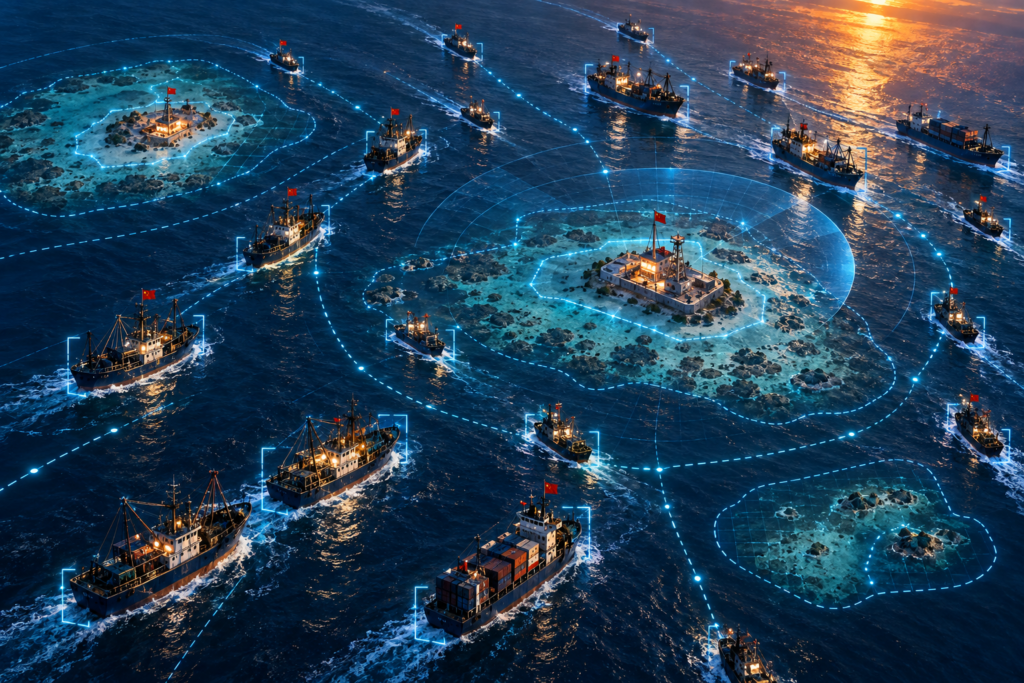
According to the source material, more than 2,000 Chinese-flagged vessels—nominally fishing boats—assembled into two enormous formations off Ningbo. Instead of trawling, the vessels reportedly maintained their positions for more than 30 hours. Weeks later, around 1,400 vessels allegedly assembled again, forcing commercial ships to navigate around or between them.
Viewed purely as a maritime-security story, the development is significant.
Viewed through the lens of global logistics and freight forwarding, it raises an even bigger question:
What happens if thousands of civilian-looking vessels can disrupt one of the world’s most important shipping corridors without a conventional naval blockade ever being declared?
The answer matters to shipping lines, freight forwarders, importers and exporters far beyond East Asia.
Because after the Red Sea, the Strait of Hormuz and repeated port disruptions, global supply chains may be confronting another form of risk—one that sits deliberately in the grey zone between civilian maritime activity and state power.
What Is China’s Maritime Militia?
China’s maritime presence in disputed waters involves more than its navy and coast guard.
Researchers have documented a substantial maritime militia consisting of vessels that can outwardly resemble commercial fishing boats while supporting state objectives.
The Asia Maritime Transparency Initiative at CSIS describes two broad components: professional maritime militia vessels and a much larger civilian Spratly Backbone Fishing Fleet. Its satellite analysis counted a record daily average of 241 militia vessels across monitored South China Sea features in 2025, up from 232 in 2024.
That distinction is important.
A naval destroyer is unmistakably military.
A fishing vessel is not.
And that ambiguity can make maritime encounters substantially more complicated.
The source describes activities ranging from swarming and shadowing to surveillance and persistent presence. Independent CSIS research similarly describes maritime militia vessels operating alongside Chinese law-enforcement and military forces in pursuit of China’s political objectives in disputed waters.
For global trade, however, the key issue is not what these vessels are called.
It is what large numbers of them could potentially do to commercial shipping.
Why Fishing Boats Could Matter to Container Shipping
Imagine a conventional maritime blockade.
Warships appear. Shipping lanes are restricted. Governments respond. Insurers reassess risk. Carriers reroute.
Now imagine something less clear.
Hundreds—or potentially thousands—of nominally civilian vessels concentrate around an important maritime corridor.
No formal blockade is announced. Commercial vessels may technically still be able to pass. Yet navigation becomes more difficult, collision risk increases and shipping lines must decide whether continuing through the area remains operationally and commercially sensible.
That distinction is crucial.
Modern container shipping depends on predictable vessel rotations. A disruption does not need to physically stop every ship to affect trade.
If it increases uncertainty enough, carriers can begin adjusting schedules and routing decisions.
And once that happens, the disruption starts travelling through the supply chain.
Why the South China Sea Matters So Much to Global Trade
This is not an obscure maritime corridor.
Roughly one-third of global maritime trade passes through the South China Sea annually, according to figures cited by UNCTAD. Researchers at Duke University have estimated trade moving through the South and East China Seas together at approximately $7.4 trillion annually.
These waters connect some of the world’s most important manufacturing and consumer economies.
China. Japan. South Korea. Taiwan. Southeast Asia.
They also sit along routes carrying electronics, machinery, consumer goods, energy, automotive components and countless intermediate products that feed factories elsewhere.
That means a serious disruption would not remain an Asian shipping problem.
It could quickly become a global supply-chain problem.
Japan and South Korea Have Particular Exposure
Few economies illustrate that vulnerability better than Japan and South Korea.
Both are major manufacturing economies with substantial dependence on imported energy. Their supply chains are deeply connected to maritime routes running through East and Southeast Asian waters.
The uploaded analysis argues that this makes maritime disruption a potential economic-security issue, rather than simply a freight issue.
Consider what happens when energy and container supply chains are disrupted simultaneously.
Energy costs rise.
Industrial production becomes more expensive.
Vessel schedules deteriorate.
Inventory buffers are consumed.
Component shortages begin appearing further downstream.
The impact can eventually reach manufacturers and consumers thousands of kilometres away.
The Red Sea Already Showed Us How Quickly Geography Can Rewrite Freight
Global logistics has recently experienced a practical demonstration of what happens when a strategically important shipping corridor becomes unsafe or unreliable.
The Red Sea crisis forced many vessels away from the Suez Canal and around the Cape of Good Hope.
Voyages became longer. Vessel capacity was absorbed by additional sailing days. Equipment cycles changed. Insurance and fuel costs increased. Schedules became less reliable.
The uploaded analysis draws the same comparison, arguing that disruption in the South China Sea could operate on an even larger commercial canvas because of the extraordinary concentration of trade moving through the region.
The lesson from the Red Sea is therefore important.
A shipping lane does not have to close completely to disrupt global logistics.
It only needs to become sufficiently risky, slow or unpredictable.
What Could a South China Sea Disruption Mean for Freight Rates?
If maritime tensions began materially affecting commercial navigation, freight markets could respond long before cargo actually stopped moving.
The first effect would likely be uncertainty.
Shipping lines and insurers would need to assess exposure. Carriers might adjust rotations or impose operational restrictions. War-risk premiums could rise. Longer routes could absorb vessel capacity.
From there, several consequences could follow:
- Longer transit times and less reliable ETAs
- Higher marine insurance and war-risk costs
- Vessel bunching and schedule disruption
- Blank sailings or altered port rotations
- Container and equipment imbalances
- Higher freight rates on affected trade lanes
- Greater inventory requirements for importers
- Pressure on alternative ports and routes
The precise impact would depend on the location, duration and severity of any disruption. It would therefore be misleading to assume that maritime militia activity automatically produces these outcomes.
But from a supply-chain risk-management perspective, the scenario deserves attention because the corridor is simply too important to ignore.
India Is More Exposed Than Many Businesses Realise
For Indian businesses, this is not a distant geopolitical story.
The source states that approximately 55% of India’s trade passes through the South China Sea and adjacent maritime routes, particularly trade connecting India with China, Japan, South Korea and the wider East Asian manufacturing ecosystem. A 2026 academic analysis similarly cites roughly 55% exposure for Indian trade through the South China Sea and adjacent routes.
Think about the cargo behind that percentage.
Electronics and electronic components.
Industrial machinery.
Automotive parts.
Chemicals.
Raw materials.
Consumer goods.
And Indian exports moving in the opposite direction.
A sustained disruption could therefore affect both India’s import supply chains and its export connectivity.
For businesses dependent on Asian sourcing, that creates a question that should already be appearing in supply-chain discussions:
If our normal shipping corridor becomes unreliable, what is Plan B?
The Bigger Logistics Lesson: Single-Corridor Dependency Is a Risk
The most useful lesson from this story is not geopolitical.
It is operational.
Global supply chains have spent decades optimizing around efficiency. Cargo is routed through the cheapest ports, fastest services and most efficient hubs.
That works extremely well—until a critical node becomes unavailable.
The pandemic exposed supplier concentration.
The Ever Given exposed chokepoint concentration.
The Red Sea exposed route concentration.
Port congestion exposed gateway concentration.
And repeated geopolitical tensions have exposed the danger of assuming that the world’s maritime highways will always remain equally accessible.
For importers and exporters, supply-chain resilience now requires route optionality.
What Should Importers and Exporters Do?
Nobody should restructure a supply chain because thousands of fishing vessels appeared in one maritime formation.
But neither should businesses wait for a crisis before understanding their exposure.
The more useful approach is to identify vulnerabilities while normal shipping conditions still provide room to make rational decisions.
Companies with significant East Asian trade should consider mapping which shipments depend on potentially exposed corridors, understanding alternative routings, reviewing insurance coverage and building realistic transit-time contingencies into critical cargo.
This becomes particularly important for businesses operating with lean inventories.
A company holding several months of safety stock can absorb a two-week delay differently from a manufacturer whose production line depends on components arriving every few days.
Risk is therefore not simply determined by the shipping lane. It is determined by how dependent your business is on that shipping lane.
Why LCL Consolidation Becomes More Important During Volatility
Disruption also changes the economics of Less than Container Load (LCL) shipping.
When uncertainty increases, importers and exporters may not always want to wait until they have sufficient cargo to fill an entire container.
LCL consolidation allows smaller consignments to move without requiring a shipper to commit to a full container, potentially giving businesses greater flexibility over shipment frequency and inventory replenishment.
But volatile periods also place greater demands on the consolidator.
A strong LCL network needs visibility across carrier schedules, transshipment hubs, consolidation points and alternative services. When one routing becomes unreliable, experienced freight forwarders must assess whether cargo can move through another hub or sailing without creating an even greater delay.
This is where LCL freight forwarding becomes more than a rate exercise.
It becomes a routing and resilience capability.
The Freight Forwarder’s Role Is Changing
There was a time when freight forwarding could largely be defined as moving cargo from origin to destination.
That definition is becoming outdated.
Today’s freight forwarder increasingly operates as an interpreter of global risk.
A port closes because of a typhoon.
A strait becomes unsafe.
A trade policy changes.
A vessel misses a connection.
A geopolitical event changes insurance conditions.
A carrier removes a port call.
The customer still needs the shipment delivered.
The value of an experienced international freight forwarder therefore lies increasingly in knowing what to do when the original plan stops working.
Technology and shipment visibility help. Global agent networks help. Carrier relationships help.
But ultimately, resilience comes from combining information with operational judgement.
Grey-Zone Maritime Activity Creates a New Kind of Supply-Chain Risk
China’s maritime militia also illustrates a broader problem confronting modern global trade.
Supply chains were built primarily to manage commercial risk.
Today’s logistics professionals increasingly have to understand geopolitical risk as well.
The boundaries are becoming less distinct.
A fishing vessel can be a commercial asset in one context and, according to analysts, support state objectives in another. CSIS research has documented the maritime militia’s role alongside Chinese coast guard and military forces, while its 2026 analysis found record militia presence across monitored South China Sea locations during 2025.
That ambiguity makes scenario planning harder.
There may be no clear moment when a logistics team can say, “the crisis has begun.”
Instead, risk can accumulate gradually.
Insurance becomes more expensive.
Carriers become more cautious.
Transit times become less predictable.
And eventually the commercial consequences become impossible to ignore.
The Next Supply-Chain Crisis May Not Begin With a Port Closure
This may be the most important takeaway.
Traditional logistics disruption is visible.
A port shuts down.
A canal closes.
A vessel grounds.
A strike begins.
Grey-zone maritime disruption can be different.
The shipping lane may technically remain open while becoming progressively more difficult, expensive or risky to use.
That means businesses cannot rely exclusively on crisis alerts.
They need continuous supply-chain visibility and contingency planning.
The companies best positioned for the next disruption will not necessarily be those that correctly predict exactly where it occurs.
They will be the ones that have built enough flexibility to respond wherever it occurs.
From the Red Sea to the South China Sea: Resilience Is Becoming a Core Logistics Capability
The uploaded analysis closes with a powerful logistics argument: single-corridor dependency creates vulnerability, and the world cannot assume that another critical maritime route will always remain unaffected simply because trade has historically flowed through it reliably.
For importers and exporters, that does not mean reacting to every geopolitical headline.
It means building supply chains capable of absorbing uncertainty.
Diversified sourcing. Alternative routing. Appropriate inventory buffers. Reliable shipment visibility. Flexible LCL and FCL options. Strong carrier and agent networks.
And above all, a freight forwarding partner capable of responding when circumstances change.
Because the next major disruption to global trade may not begin with a container ship stuck across a canal or missiles targeting vessels.
It could begin with thousands of boats that still look, at first glance, like they are simply there to fish.
Build More Resilience Into Your International Supply Chain
At Global Logistics, we help importers and exporters navigate changing global trade conditions through international freight forwarding, LCL consolidation, FCL, air freight and flexible routing solutions.
When trade lanes change, having alternatives matters.
Connect with our team to explore smarter routing and consolidation options for your international cargo.