
𝗖𝘂𝘀𝘁𝗼𝗺𝘀 𝗰𝗹𝗲𝗮𝗿𝗮𝗻𝗰𝗲 𝗶𝗻 𝗜𝗻𝗱𝗶𝗮 𝗰𝗼𝘂𝗹𝗱 𝘀𝗼𝗼𝗻 𝗴𝗲𝘁 𝘀𝗺𝗮𝗿𝘁𝗲𝗿 with AI.
For decades, customs enforcement has faced an uncomfortable trade-off.
Inspect more cargo, and legitimate shipments risk being delayed. Inspect less, and prohibited, counterfeit or misdeclared goods have a greater chance of slipping through.
India now wants technology to change that equation.
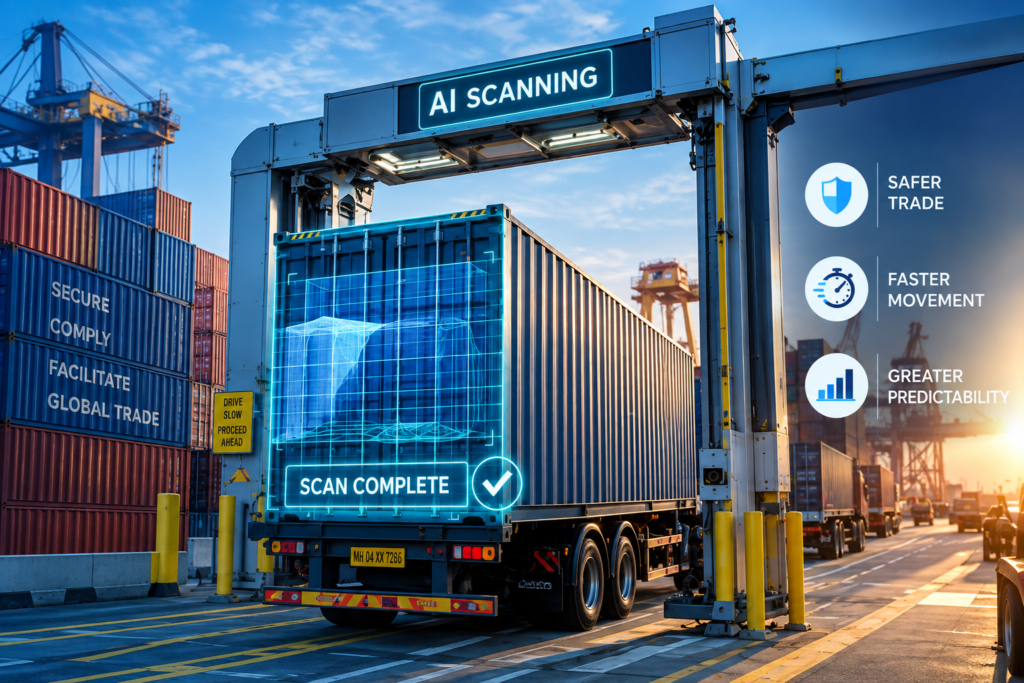
The Central Board of Indirect Taxes and Customs (CBIC) plans to significantly expand the use of artificial intelligence, advanced image analytics and non-intrusive cargo scanning technologies, with the longer-term objective of creating a phased system capable of scanning every consignment entering the country.
But the more important story for importers, exporters and freight forwarders is not simply that customs is adopting AI.
It is why.
The stated objective is to move customs enforcement away from dependence on physical inspection and towards intelligence-led, technology-driven risk assessment—making legitimate trade faster, safer and more predictable while improving the ability to identify suspicious cargo.
For an industry where hours at a port can translate into inventory delays, detention costs and missed delivery commitments, that could have significant implications.
Why AI-Powered Customs Scanning Matters to Indian Trade
Global trade operates on speed, but customs operates on certainty.
Every container entering a country represents a decision. Should it move through quickly? Does the documentation match the cargo? Does its scanning image reveal something unusual? Does its importer, commodity, origin or declared value indicate greater risk?
Historically, physical examination has been one of the tools available to answer those questions.
The problem is scale.
As trade volumes grow, manually examining substantially more cargo can create bottlenecks. The smarter alternative is not necessarily to inspect everything physically, but to improve the ability to identify which shipments actually require intervention.
That is where AI-powered cargo scanning becomes important.
Advanced image analytics can help customs authorities interpret scanning data, while risk-assessment systems can potentially bring together multiple signals to identify anomalies requiring closer examination.
The ambition is therefore bigger than installing more scanners.
It represents a transition from inspection-led customs to intelligence-led customs.
From “Stop and Inspect” to “Scan, Assess and Intervene”
For legitimate businesses, the distinction could be significant.
A conventional inspection model can introduce uncertainty because physical examination may involve cargo handling, container opening and additional processing time.
A technology-led system creates the possibility of screening more cargo without subjecting every shipment to the same degree of physical intervention.
CBIC Chairman Vivek Chaturvedi described the objective as making the movement of legitimate commerce “faster, safer and predictable.”
That last word matters particularly to supply chains.
Predictability is often as valuable as speed.
An importer can plan around a known three-day process. What is much harder to manage is a shipment expected tomorrow that unexpectedly spends several additional days awaiting clearance.
For manufacturers operating lean inventories, retailers managing seasonal merchandise, or businesses importing time-sensitive components, customs variability can ripple through the entire supply chain.
AI-enabled risk assessment therefore has the potential to improve something logistics companies constantly work to deliver: reliable cargo flow.
What Could AI Actually Change at Indian Customs?
The real value of artificial intelligence lies in its ability to analyse information at a scale and speed humans cannot easily replicate.
A sophisticated customs risk system could use technology to identify unusual patterns across shipment information, documentation and scanning imagery, allowing officers to concentrate attention where the risk appears greatest.
In practical terms, a more mature technology-led customs environment could help authorities distinguish more efficiently between ordinary legitimate trade and consignments requiring deeper scrutiny.
For compliant importers, that potentially means fewer unnecessary interventions.
For customs authorities, it means resources can be directed toward higher-risk cargo rather than treating every container as equally suspicious.
And for the broader logistics ecosystem, it could mean better throughput without requiring security standards to be diluted.
The Numbers Show Why Smarter AI Enforcement Matters
The scale of illicit trade also explains why India is investing in this capability.
According to the attached report, the Directorate of Revenue Intelligence booked more than 3,000 commercial cases involving approximately ₹4,000 crore in duty, export and incentive amounts during 2024–25.
The CBIC chairman also highlighted how illicit trade has evolved beyond conventional cross-border movement of prohibited goods, with criminal networks increasingly exploiting legitimate logistics infrastructure and documentation.
That creates a difficult challenge.
The same networks, containers, warehouses, freight systems and documentation processes that make international commerce possible can potentially be misused by illicit operators.
The objective therefore cannot simply be to make customs faster.
It must be to make customs faster at identifying legitimate trade and more precise at detecting suspicious trade.
Why This AI Shift Matters for Freight Forwarders
Freight forwarding sits directly at the intersection of cargo, documentation, customs and transportation.
A shipment does not move efficiently simply because space has been booked on a vessel.
The commercial invoice must be correct. Classification must be appropriate. Documentation needs to match the consignment. Customs requirements must be understood. The shipment needs to reach the right terminal at the right time. And any exception needs to be resolved before it becomes an expensive delay.
As customs becomes more data-driven, documentation quality becomes even more important.
AI systems are particularly effective at identifying patterns and anomalies. In a technology-driven customs environment, inconsistencies between declarations, cargo descriptions and other shipment data could therefore attract greater scrutiny.
For importers and freight forwarders, digitisation should not be interpreted as an opportunity to become less careful with documentation.
It is a reason to become more precise.
Could AI Reduce Customs Clearance Delays?
Potentially—but technology alone will not guarantee faster clearance.
The strongest outcome would come from combining non-intrusive scanning with intelligent risk profiling, integrated documentation, efficient port processes and appropriately staffed customs operations.
If these systems work together, legitimate low-risk shipments could potentially move with less intervention while customs concentrates resources on anomalies.
That matters because customs clearance is only one link in a much larger chain.
When clearance slows, containers occupy terminal space for longer. Trucks wait. Warehouses receive cargo later. Equipment circulation can become less efficient. Importers face additional inventory uncertainty.
When clearance becomes more predictable, the benefits can travel in the opposite direction.
Better cargo flow can improve terminal planning, inland transportation, inventory management and customer delivery schedules.
What Does This AI shift Mean for LCL Consolidation?
The implications become particularly interesting for Less than Container Load (LCL) shipments.
An FCL container generally represents one shipper’s full-container consignment. An LCL container, by contrast, can contain multiple individual consignments belonging to different customers.
That makes documentation and cargo identification especially important.
A well-managed LCL operation depends on accurate shipment descriptions, manifests, consolidation records, customs documentation and coordination between origin and destination teams.
As cargo screening becomes more sophisticated, experienced LCL freight forwarders and NVOCCs will have an increasingly important role in maintaining clean documentation and shipment visibility throughout the consolidation chain.
Technology may automate parts of customs assessment.
It does not remove the need for disciplined freight operations.
In fact, it increases it.
AI Is Changing More Than Customs
The development also reflects a much broader transformation underway across logistics.
Artificial intelligence is moving into almost every stage of international freight.
Shipping lines are using predictive systems for network and capacity planning. Ports are increasingly automating terminal operations. Freight forwarders are using technology for rate management, documentation and shipment visibility. Warehouses are deploying automation for inventory and fulfilment.
Now border agencies are becoming part of the same digital ecosystem.
The future international shipment could therefore move through a chain in which technology helps predict demand before cargo is booked, optimize the route, track the container, analyse documentation, assess customs risk and identify potential disruption before the consignee even knows there is a problem.
But this does not mean freight forwarding becomes less human.
Quite the opposite.
As routine processing becomes increasingly automated, the value of a freight forwarder shifts towards judgement, exception management, compliance expertise and problem-solving.
Technology handles what is predictable.
Expertise becomes most valuable when something isn’t.
The Bigger Shift: From Faster Logistics to Predictable Logistics
For years, the logistics industry has sold speed.
Faster transit. Faster clearance. Faster delivery.
But global supply chains have demonstrated repeatedly that the cheapest or fastest route on paper is not necessarily the most valuable one.
Businesses increasingly need predictability.
They need to know where cargo is, whether documentation is correct, whether customs clearance could become an issue and whether a disruption threatens the promised delivery date.
India’s proposed shift towards AI-powered, non-intrusive cargo assessment fits into that larger evolution.
The ultimate measure of success will not simply be how many containers customs can scan.
It will be whether technology allows authorities to identify risk more accurately while allowing legitimate trade to move with fewer unnecessary disruptions.
And that is where customs modernization and modern freight forwarding share the same objective.
Move the right cargo. With the right information. Through the right controls. With as little unnecessary friction as possible.
What Should Importers and Exporters Do Now?
Businesses do not need to wait for every new customs technology to be deployed before preparing for a more data-driven trading environment.
The fundamentals are already clear: maintain accurate product descriptions and classifications, ensure documentation is consistent across the shipment, work with freight partners who understand customs requirements, digitize records wherever practical, and treat compliance as part of supply-chain planning rather than an administrative task after cargo has moved.
For LCL shippers in particular, choosing a freight forwarder with strong consolidation processes becomes important because multiple consignments, documents and stakeholders must remain aligned throughout the journey.
The smarter customs becomes, the greater the advantage of having clean data and disciplined logistics processes from origin onwards.
AI Won’t Remove Friction From Trade. It Can Help Put the Friction in the Right Place.
There will always be tension between facilitating trade and securing borders.
The answer is not simply more inspection.
Nor is it less inspection.
The opportunity lies in better inspection.
If India succeeds in combining AI, advanced image analytics, non-intrusive scanning and intelligence-led risk assessment at scale, customs authorities could focus intervention where it is genuinely required while making compliant cargo movement more predictable.
For importers and exporters, that means technology at the border could eventually become more than an enforcement mechanism.
It could become part of India’s trade facilitation infrastructure.
And for freight forwarders, the message is equally clear.
The future of logistics will not be defined by technology alone. It will belong to businesses capable of combining technology, compliance expertise, accurate documentation, global connectivity and operational experience to keep cargo moving.
At Global Logistics, we help importers and exporters navigate international freight with reliable LCL consolidation, ocean freight and end-to-end freight forwarding solutions designed around visibility, coordination and efficient cargo movement.
Speak to our team to plan your next international shipment with greater confidence.