
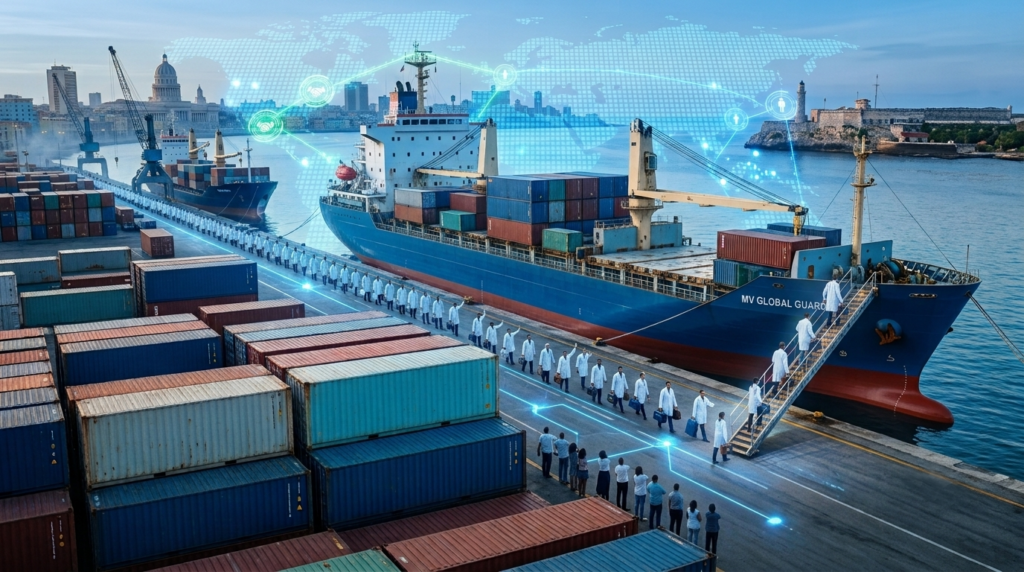
When 128 Cuban doctors boarded a charter flight from Honduras to Havana in February 2026, the farewell outside an eye clinic in San José de Colinas looked like a healthcare story. Residents gathered to say goodbye. Some were reportedly in tears. A medical arrangement that had operated in Honduras since 1998 was ending.
But look at the same event through the lens of international trade, and something else becomes visible.
A long-standing service contract had ended. A supplier had lost a market. And the customer suddenly faced one of the oldest problems in supply chain management:
What happens when you remove a critical supplier before securing an alternative?
Cuba offers a fascinating case study because its most valuable export is not the product most people associate with the island. It isn’t rum, cigars or sugar.
It is human expertise.
Cuba has generated billions of dollars from exporting professional services, with medical professionals accounting for a substantial share of its overseas workforce.
Behind this unusual export model is a much larger story about capacity building, pricing, dependency, geopolitics and supplier concentration—concepts that will sound remarkably familiar to anyone working in global trade, freight forwarding or supply chain management.
How Cuba Turned Medical Education Into Export Capacity
Cuba did not accidentally end up with an unusually large medical workforce.
Following the Cuban Revolution, the country’s healthcare system faced an extraordinary capacity problem. Roughly 2,000 of its approximately 6,000 physicians left the country, creating a severe shortage of doctors and medical educators.
The government responded by rebuilding medical education at enormous scale.
Medical education became free, removing the financial barrier to entering the profession. Over the following decades, Cuba dramatically expanded the number of doctors it trained. Today, the country has around 90,000 doctors serving a population of approximately 11 million.
Most countries primarily view education as social infrastructure.
Cuba also effectively created export capacity.
It invested in producing a resource domestically before an international market for that resource had fully developed.
In supply-chain terms, Cuba built capacity first—and found customers later.
What Happens When Human Capital Becomes a Country’s Export?
Normally, when we discuss exports, we think about physical goods.
A manufacturer produces something. A freight forwarder moves it. Customs clears it. An overseas customer buys it.
Services trade operates differently.
Nothing necessarily enters a container.
Yet the commercial fundamentals are remarkably similar.
There is supply and demand. There are contracts, capacity constraints and customers. There are different pricing structures. There is geopolitical risk. And, perhaps most importantly, there is supplier dependency.
Cuba’s medical programme turned skilled labour into an exportable national capability.
But there was an economic contradiction at its centre.
The country had spent decades developing a large pool of highly trained medical professionals while its domestic economy struggled to provide comparable earning opportunities. Doctors could earn extremely low state salaries at home, while overseas assignments offered the possibility of significantly higher earnings.
That imbalance became part of the economics underpinning Cuba’s medical-services trade.
How Cuba’s Medical Export Model Actually Works
The structure of Cuba’s system is particularly interesting from a trade perspective.
Under this model, individual doctors do not simply travel abroad and negotiate employment independently.
Instead, Cuba signs government-to-government contracts.
The host country pays the Cuban government. The government compensates the medical professional, while retaining a portion of the payment as state revenue.
Brazil, for example, paid the Cuban government around $3,600 per doctor per month, while critics estimated that roughly 20% went to the worker.
Cuba therefore effectively became the central exporter, employer and negotiator.
And then the model becomes even more interesting.
Because Cuba did not charge every customer the same price.
Cuba Was Effectively Practising Yield Management
If you are familiar with airlines or ocean freight, you will recognise the underlying principle.
The same airline seat can sell at dramatically different prices depending on demand and availability.
A container slot can command very different freight rates depending on the trade lane, season, capacity and market conditions.
Cuba’s medical-services model operated with a similarly differentiated structure.
Some countries paid commercial rates. Others received Cuban medical personnel at little or no direct cost. Wealthier customers therefore effectively helped subsidise programmes in poorer countries.
In 2017, Cuban medical professionals were working in around 62 countries, with approximately 27 host governments paying nothing.
Then there was Venezuela.
Instead of simply paying Cuba in dollars, Venezuela supplied subsidised oil in exchange for medical services—at one stage reaching as much as 100,000 barrels per day.
For Cuba, which faced restrictions involving the US financial system, the arrangement reduced reliance on conventional dollar settlement.
It was effectively services-for-energy trade.
Unconventional, certainly.
But commercially sophisticated.
When Professional Services Become Bigger Than Traditional Exports
The scale eventually became remarkable.
When Cuba separately reported health-service exports in 2018, the figure was approximately $6.4 billion—more than tourism, sugar and nickel combined.
There is an important lesson here for developing economies.
A country’s competitive advantage does not necessarily have to be something extracted from the ground or manufactured in a factory.
Knowledge can be exported. Skills can be exported. Expertise can be exported.
India already understands this particularly well.
Software services demonstrated that a country could build globally valuable export capacity around human capital without putting the primary product inside a shipping container.
Cuba took a different version of that principle into healthcare.
But its model also came with serious controversy.
The Ethical Problem Behind Cuba’s Medical Export Model
The commercial ingenuity of the system cannot be separated from the conditions under which some workers reportedly participated.
Cuba has historically presented its overseas medical programmes as humanitarian solidarity, and those programmes have placed healthcare professionals in communities where recruiting sufficient local doctors can be difficult.
At the same time, critics and former participants have alleged coercive practices, including restrictions on movement, withholding of passports, supervision and penalties for abandoning overseas assignments.
This creates a complicated reality. Overseas assignments could allow some Cuban healthcare professionals to accumulate savings that would be extremely difficult to earn domestically, while the system itself has faced serious allegations concerning workers’ freedom.
Both realities matter.
A commercially successful export model cannot be evaluated solely on revenue.
How that value is created matters too.
Increasingly, the same principle applies throughout global supply chains.
From forced-labour regulations to ESG requirements and supplier audits, businesses are being asked to understand not simply where their products come from, but under what conditions they are produced.
Cuba’s medical export system brings the same question into services trade.
When Geopolitics Disrupts the Supply Chain
In February 2025, Washington announced visa restrictions targeting officials associated with these arrangements and their families. Through 2026, several countries subsequently reduced or ended arrangements involving Cuban medical professionals.
The affected markets included Honduras, Jamaica, Paraguay, the Bahamas, Guyana, Antigua, Saint Vincent and Guatemala. Revenues have also declined substantially from the earlier $6.4 billion level.
For Cuba, that means lost export revenue.
But there is another side to the equation.
The Single-Supplier Problem: Removing Supply Does Not Remove Demand
This is where Cuba’s story becomes particularly relevant to logistics and supply-chain strategy.
Many Cuban doctors were deployed in places struggling to recruit enough local healthcare professionals.
Remove the Cuban programme and the underlying demand for doctors does not disappear.
The clinic still needs physicians.
The community still needs healthcare.
The shortage still exists.
Only the supplier has disappeared.
In procurement language, this is single sourcing without a qualified alternative.
It is the same vulnerability businesses discover when they depend almost entirely on one supplier, factory, port or shipping corridor.
Everything works efficiently until something changes.
A tariff appears. A war begins. A factory shuts. A port becomes congested. A shipping route becomes unsafe. Or geopolitics makes the supplier commercially unavailable.
At that point, discovering that there is no alternative is already too late.
What Cuba’s Doctors Can Teach Us About Supply Chain Resilience
The lesson is not that every business needs to duplicate every supplier.
That would often be expensive and inefficient.
The lesson is that concentration risk needs to be understood before disruption occurs.
A manufacturer dependent on one overseas factory faces supplier concentration risk. An importer dependent on a single shipping line faces capacity risk. A business relying on one port faces gateway risk. A supply chain dependent on one maritime corridor faces route risk.
And a healthcare system dependent on one overseas medical programme faces human-capital supply risk.
The cargo changes.
The supply-chain principle does not.
Resilient businesses identify their critical dependencies and develop alternatives while they still have the luxury of time.
What This Teaches Us About Freight Forwarding
At first glance, Cuban doctors and freight forwarding have very little in common.
Strategically, however, the parallels are striking.
Modern freight forwarding is increasingly about managing dependencies.
A forwarder needs to understand which carrier has capacity, which port is congested, which transshipment hub creates additional exposure, which trade lane is facing disruption and which alternative routing can keep a customer’s cargo moving.
This becomes particularly important in LCL consolidation.
An LCL shipment can involve origin consolidation, mainline transportation, transshipment, destination deconsolidation and final delivery. A disruption at one point can affect multiple consignments simultaneously.
The value of a strong LCL network therefore goes beyond obtaining a competitive freight rate.
It lies in having options—alternative sailings, carriers, consolidation hubs and routings.
Because the true test of a supply chain is rarely how efficiently it performs when everything works.
It is how quickly it adapts when something stops working.
India Offers a Fascinating Contrast
Cuba’s story becomes even more interesting when compared with India.
India is also a major exporter of human capital.
Indian-trained doctors and nurses work across markets such as Britain, the Gulf and the United States. But the structure is fundamentally different.
Healthcare professionals generally migrate individually. Overseas employers compensate them directly. India benefits indirectly through the remittances they send home.
Now compare that with another Indian export success: technology services.
Here, the structure historically looks somewhat closer to Cuba’s model.
An overseas customer contracts an Indian technology company. The company employs the engineer. The customer pays the company. The company pays the employee and retains its commercial margin.
But there is one decisive distinction:
The employee is free to leave.
This gives us three very different human-capital export models.
Cuba centralises the commercial relationship through the state. Indian technology exports expertise through corporations. Indian healthcare largely exports professionals through individual migration.
Each distributes economic value differently between the worker, institution and country.
That raises a bigger question for the future of services trade:
Can countries create scalable human-capital export models that reward workers fairly, compensate the systems that train them and still solve genuine labour shortages in destination markets?
The opportunity extends far beyond healthcare.
The Future of Global Trade Is Bigger Than Containers
For a logistics company, Cuba’s story is valuable precisely because there are no containers involved.
Global trade is evolving.
Countries export software without shipping a box. Consultants deliver expertise across borders digitally. Engineers relocate to build infrastructure. Healthcare professionals move to markets where skills are scarce. Data itself is becoming an internationally traded economic resource.
Yet beneath these very different models are the same principles that have always governed physical supply chains:
Capacity. Demand. Pricing. Contracts. Dependencies. Risk. Alternatives. Resilience.
Understanding international trade therefore requires looking beyond what moves through a port.
Sometimes a country’s most valuable export walks onto the aircraft itself.
The Most Important Supply Chain Question: What Is Your Alternative?
Cuba spent decades building an extraordinary supply of medical expertise and found international customers willing to pay for it.
The system generated billions in revenue and placed doctors in communities that often struggled to recruit them.
It also created serious ethical questions around how those professionals were compensated and controlled.
Now geopolitical pressure is testing that model.
But ending a problematic supply arrangement does not automatically solve the customer’s underlying problem.
If a clinic loses its doctors and nobody replaces them, demand has not disappeared.
Supply has.
That is a lesson every importer, exporter and supply-chain professional should recognise.
Never confuse cancelling a supplier with solving a supply problem.
Whether the dependency involves doctors, semiconductors, raw materials, vessel capacity or an LCL consolidation route, the principle remains the same:
Before removing a critical link from your supply chain, know what will replace it.
Build Supply Chains With More Than One Way Forward
Global trade is increasingly shaped by geopolitics, changing regulations, capacity constraints and unexpected disruptions.
At Global Logistics, we help importers and exporters navigate this uncertainty through international freight forwarding, LCL consolidation, FCL, air freight and flexible global routing solutions.
Contact our team to know more