India moves more than US$1.2 trillion worth of goods across its borders every year. Every day, thousands of containers enter and leave the country’s ports carrying everything from electronics and pharmaceuticals to machinery, textiles and food products.
The overwhelming majority of this cargo belongs to legitimate businesses that rely on fast, predictable customs clearance to keep global supply chains moving. Yet hidden among these shipments are containers that are deliberately misdeclared, undervalued, counterfeit or prohibited. These not only result in significant revenue losses for the government but also create unfair competition, compromise consumer safety and strengthen organised criminal networks.
For customs authorities, the challenge has always been balancing two competing priorities: strengthening enforcement without slowing legitimate trade.
Artificial Intelligence (AI) may finally provide the answer.
India is now moving towards one of the most significant changes in its customs ecosystem—combining AI, advanced imaging and non-intrusive cargo scanning to inspect containers without opening them. If implemented successfully, this could fundamentally reshape customs operations, improve supply chain security and accelerate international trade.
Why Traditional Customs Inspections Are No Longer Enough
Global trade has changed dramatically over the past decade.
Smuggling today rarely resembles dramatic border chases portrayed in films. Instead, illicit goods increasingly move through legitimate logistics channels, complete with genuine shipping documentation, established freight forwarders and regular port infrastructure.
Modern customs fraud can involve:
- Under-declaration of cargo value
- Incorrect product classification
- Counterfeit products
- Misuse of export incentive schemes
- Concealment of prohibited or restricted goods
- False country-of-origin declarations
These sophisticated methods make physical inspections alone inadequate.
Opening containers manually is labour-intensive, time-consuming and expensive. More importantly, physically examining every shipment would create severe congestion at ports, increase logistics costs and delay cargo movement across the supply chain.
As India’s international trade continues to expand, customs enforcement must become smarter rather than slower.
India’s Vision: Scan Every Container Without Slowing Trade
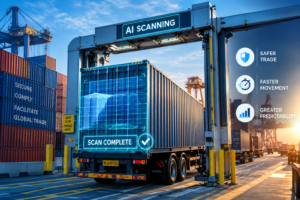
India’s customs authorities are now working towards expanding non-intrusive container scanning supported by artificial intelligence and advanced image analytics.
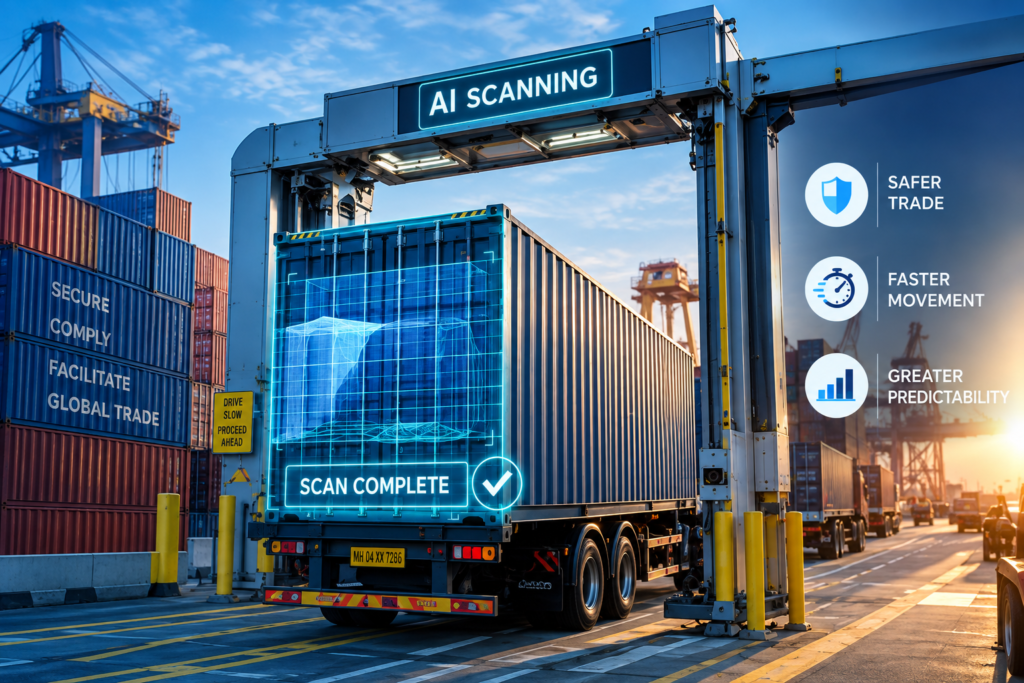
Instead of relying primarily on manual inspections, containers would pass through high-capacity scanning systems capable of analysing their contents while cargo continues moving through the terminal.
The objective is not to inspect every container physically.
The objective is to inspect every container intelligently.
By combining advanced imaging technology with AI-driven risk assessment, customs officials can identify suspicious shipments more accurately while allowing compliant cargo to move faster.
This represents a significant shift in customs philosophy—from reacting after violations occur to identifying risks before they disrupt the supply chain.
Moving From Seizures to Prevention
Historically, customs performance was often measured by the number of seizures and arrests.
Today, that approach is evolving.
Technology enables customs authorities to identify high-risk consignments earlier, allowing enforcement resources to focus where they are most needed rather than treating every shipment as equally suspicious.
This intelligence-led approach offers several advantages:
- Reduced unnecessary inspections
- Faster clearance for compliant cargo
- Better targeting of high-risk shipments
- More efficient use of customs resources
- Greater supply chain predictability
Instead of slowing every shipment, AI allows customs authorities to concentrate on containers that genuinely warrant further investigation.
Why Illicit Trade Remains a Major Challenge
Illicit trade extends far beyond narcotics or precious metals.
Counterfeit consumer goods, fake medicines, uncertified toys, illegally imported food products and improperly declared commercial cargo all contribute to a growing underground economy.
These activities create multiple risks:
Revenue Loss
Incorrect declarations reduce customs duty collections and weaken public finances.
Unfair Competition
Businesses that comply with regulations struggle to compete against operators who evade duties or circumvent compliance requirements.
Consumer Safety
Counterfeit medicines, cosmetics, electronics and children’s products may bypass quality certifications, creating significant health and safety risks.
National Security
Illicit trade networks often intersect with organised crime, money laundering and other illegal activities that threaten economic security.
For customs authorities, identifying these risks without interrupting legitimate commerce has become increasingly important.
Why AI Makes Cargo Scanning More Effective
Traditional cargo scanners generate enormous volumes of images.
The challenge has never been capturing those images.
The challenge has been analysing them quickly enough to support real-time customs decisions.
Artificial Intelligence changes that equation.
Modern AI-powered image analysis systems can compare scanned cargo with shipping declarations and identify anomalies that may warrant additional inspection.
Rather than replacing customs officers, AI acts as an intelligent assistant capable of processing thousands of images rapidly while highlighting containers that deserve closer examination.
Potential capabilities include:
- Detecting inconsistencies between declared and actual cargo
- Identifying concealed goods
- Estimating expected cargo density
- Recognising unusual loading patterns
- Highlighting suspicious areas within containers
Human officers continue making final enforcement decisions, but AI significantly improves the speed and consistency of risk identification.
The Critical Role of Data Before the Container Arrives
Advanced scanning alone cannot transform customs operations.
The real intelligence comes from combining images with digital trade information submitted before the vessel reaches port.
Today’s customs systems already receive extensive shipment data electronically, including:
- Importer and exporter information
- Product classifications
- Cargo descriptions
- Shipping documentation
- Bills of lading
- Manifest information
- Consignment details
When AI compares these declarations with scanned images, discrepancies become much easier to identify.
If documentation describes garments but the scan reveals dense metallic cargo, the system can automatically flag the shipment for further examination.
The scanner sees inside the container.
The data explains what should be inside.
Together, they create a far more powerful customs risk assessment system.
How AI Could Improve Supply Chain Efficiency
For importers and exporters, faster customs clearance is not simply a matter of convenience.
It directly influences inventory costs, production schedules and customer satisfaction.
If AI enables customs authorities to reduce unnecessary physical inspections, businesses could benefit through:
- Faster cargo clearance
- Reduced port congestion
- Lower demurrage and detention costs
- Improved shipment predictability
- Better inventory planning
- Reduced working capital tied up in delayed cargo
Predictability often creates more value than speed alone.
When businesses know their cargo will move consistently through customs, they can optimise inventory levels and improve supply chain planning.
Why Freight Forwarders Must Prioritise Data Accuracy
The shift towards AI-driven customs changes the role of freight forwarders.
Success will increasingly depend not only on moving cargo efficiently but also on ensuring documentation accuracy.
As customs systems become more data-driven, inconsistent or incomplete shipment information could trigger additional scrutiny.
This places greater emphasis on:
- Accurate cargo descriptions
- Correct HS classifications
- Consistent shipping documentation
- Complete manifest filings
- Proper customs declarations
For LCL (Less than Container Load) shipments, documentation becomes even more critical.
Because multiple shippers share a single container, one inaccurate declaration may result in the entire container being selected for inspection, affecting every importer and exporter sharing that shipment.
For LCL consolidators, cargo verification and documentation quality will become increasingly important competitive advantages.
Challenges India Must Address
The vision of AI-powered customs is promising, but implementation will require careful execution.
Infrastructure Capacity
High-volume scanning systems must process large numbers of containers without creating new bottlenecks at busy ports.
Poorly positioned scanning infrastructure could shift congestion from inspection bays to scanner queues.
AI Accuracy
Artificial intelligence must minimise false positives.
If too many compliant shipments are flagged unnecessarily, customs efficiency gains could quickly disappear.
Data Quality
AI systems are only as reliable as the information they receive.
Incomplete or inaccurate declarations reduce the effectiveness of automated risk assessment.
Evolving Smuggling Techniques
As customs technology improves, illicit networks will continue adapting their methods.
Technology must therefore evolve continuously rather than remain static.
What This Means for India’s Logistics Industry
AI-driven customs represents more than a technology upgrade.
It signals a broader transformation in how international trade will be managed.
Freight forwarders, customs brokers, shipping lines and logistics providers will increasingly compete on operational accuracy, digital integration and documentation quality—not just freight rates.
Businesses that invest in compliance, digital documentation and supply chain visibility are likely to benefit from faster customs processing and lower operational risk.
Those relying on outdated manual processes may face increasing delays as customs systems become more intelligent.
For the logistics industry, data is rapidly becoming as valuable as physical infrastructure.
AI Will Not Replace Customs Officers—It Will Empower Them
Artificial Intelligence is often viewed as a replacement for human expertise.
In customs operations, the opposite is more likely.
AI can process enormous volumes of information far faster than people.
But judgement, investigation and enforcement decisions will continue to depend on experienced customs professionals.
Technology helps identify risks.
People decide how to respond.
That combination offers the greatest opportunity to improve both trade facilitation and border security.
The Future of Customs Lies in Intelligent Trade Facilitation
India’s ambition to combine AI with non-intrusive cargo scanning reflects a broader shift taking place across global trade.
Customs authorities worldwide are moving away from random inspections towards intelligence-driven risk management that protects supply chains while supporting economic growth.
For importers, exporters and freight forwarders, this evolution offers significant opportunities.
Faster cargo movement, greater transparency and improved predictability can strengthen international trade competitiveness while reducing unnecessary delays.
However, success will depend on more than advanced scanners.
It will require accurate data, integrated digital systems, efficient infrastructure and close collaboration between government agencies and the logistics industry.
The future of customs is unlikely to be defined by how many containers are opened.
It will be defined by how intelligently countries identify the few that truly need to be.
Partner with a Freight Forwarder Ready for the Future
As customs procedures become increasingly digital and data-driven, businesses need logistics partners who understand both operational efficiency and regulatory compliance.
At Global Logistics, we help importers and exporters navigate evolving customs requirements through reliable freight forwarding, LCL consolidation, FCL shipping, customs coordination and end-to-end logistics solutions.
Whether you’re moving cargo across Asia, Europe, the Middle East or the Americas, our expertise helps ensure smoother documentation, predictable cargo movement and greater supply chain confidence.
Connect with Global Logistics to build smarter, faster and more resilient international supply chains.