
A Plane Flew Over Silicon Valley With Three Shocking
Imagine attending one of the world’s biggest software conferences alongside founders, investors, and technology leaders responsible for building billion-dollar companies.
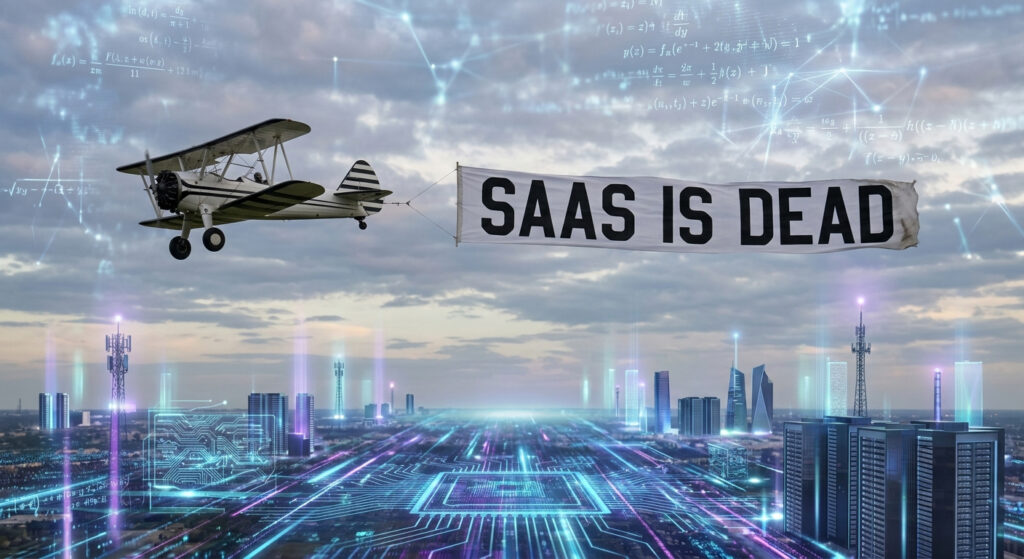
Then imagine looking up to see a plane towing a banner that simply reads:
“SaaS is dead.”
It wasn’t a publicity stunt by an outsider. It was funded by a former SaaS CEO, making it one of the boldest statements yet about the future of enterprise software.
For nearly two decades, Software-as-a-Service (SaaS) dominated the technology landscape. Companies like Salesforce, Slack, Zoom, Adobe, and Workday transformed how businesses operated, creating trillion-dollar markets and redefining enterprise productivity.
Today, however, artificial intelligence is forcing the software industry to rethink everything.
The debate is no longer about whether AI will change software. It is about whether traditional software itself will survive.
More importantly, the disruption extends far beyond Silicon Valley. It has profound implications for India’s IT industry, enterprise technology, and even logistics platforms that power global supply chains.
Why AI Is Challenging the Traditional SaaS Model
Traditional SaaS platforms were designed to help people complete tasks more efficiently.
Customer relationship management systems helped sales teams organize leads. Accounting software simplified financial reporting. Transportation Management Systems (TMS) helped logistics teams coordinate freight.
In every case, software functioned as a tool.
Artificial intelligence is fundamentally changing that relationship.
Instead of helping users perform work, AI increasingly performs the work itself.
Modern AI agents can qualify leads, generate reports, analyze operations, forecast demand, draft emails, answer customer queries, and automate workflows with minimal human intervention.
This shift changes the very purpose of software.
Why Many SaaS Companies Are Being Forced to Reinvent Themselves
Many software companies initially responded by adding AI features to their existing platforms.
But integrating AI into legacy software has often proven insufficient.
As one founder described it, adding AI to traditional SaaS is like “attaching an engine to a horse-drawn carriage.” The technology becomes more powerful, but the underlying architecture was never designed for it.
The companies adapting most successfully are taking a far more radical approach.
Rather than simply enhancing existing products, they are rebuilding them with AI at the core.
These next-generation platforms no longer assist employees—they increasingly operate as autonomous digital teammates capable of executing entire business processes independently.
The Market Is Already Reflecting This Shift
Investor sentiment has changed dramatically.
Several publicly listed SaaS companies have experienced significant valuation declines as investors reassess long-term growth expectations.
Meanwhile, AI-native businesses are attracting increasing customer adoption and investment because they offer fundamentally different productivity models rather than incremental software improvements.
The market is effectively separating companies into two categories:
- Businesses using AI to enhance traditional software.
- Businesses rebuilding software around AI-first architectures.
Increasingly, investors appear to favor the second group.
What Does This Mean for India’s Technology Industry?
Although much of the conversation originates in Silicon Valley, the implications for India are substantial.
India has become one of the world’s largest software development and IT services hubs. Millions of professionals work across enterprise software, consulting, implementation, and digital transformation.
As enterprise software evolves, so too must the companies building and supporting it.
Several Indian technology firms have already begun restructuring operations, investing in AI capabilities, and introducing AI-powered products to remain competitive.
The transformation is not necessarily reducing demand for technology expertise.
Instead, it is changing the nature of that expertise.
Future competitive advantage will increasingly depend on professionals capable of designing, managing, supervising, and optimizing AI systems rather than simply developing conventional software.
Why Domain Expertise May Become More Valuable Than Generic AI
One of the most important lessons emerging from the AI revolution is that larger models do not automatically create greater business value.
General-purpose AI can answer questions across countless subjects.
However, businesses often require highly specialized knowledge.
A logistics company needs AI that understands freight documentation, customs regulations, Incoterms, shipment tracking, container planning, and supply chain operations—not just general conversation.
This is where domain-specific AI models become particularly valuable.
Rather than competing to build the largest language models, organizations can create focused AI solutions tailored to industries such as banking, healthcare, manufacturing, insurance, or logistics.
For Indian technology companies, this represents a significant opportunity.
How AI Will Transform Freight Forwarding and Logistics Technology
The logistics industry faces many of the same questions confronting enterprise software.
Transportation Management Systems (TMS), freight visibility platforms, warehouse management systems, customs software, and rate management tools have traditionally functioned as decision-support systems.
Artificial intelligence has the potential to fundamentally redefine these platforms.
Instead of simply displaying shipment data, AI can:
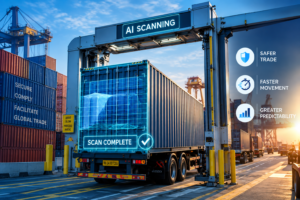
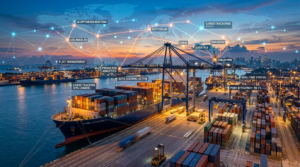
- Monitor shipments in real time
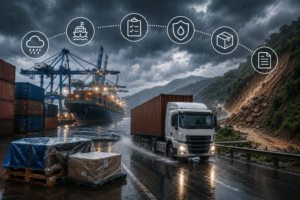
- Predict delays before they occur
- Recommend alternative routing options
- Generate freight documentation
- Optimize container utilization
- Forecast transportation demand
- Automate customer communication
- Support customs compliance
- Improve LCL consolidation planning
Rather than replacing logistics professionals, AI enables them to manage increasingly complex supply chains with greater speed and accuracy.
For freight forwarders, the competitive advantage will increasingly lie in combining industry expertise with intelligent automation.
The Future of Work Is About Productivity, Not Headcount
Much of the public conversation around AI focuses on workforce reduction.
A more strategic perspective is emerging.
Instead of replacing employees, many organizations are seeking to dramatically increase productivity.
AI enables experienced professionals to complete work faster, analyze more information, and manage greater operational complexity.
For businesses, the opportunity lies not simply in reducing costs but in delivering more value with existing teams.
Organizations that successfully combine skilled professionals with intelligent AI systems are likely to outperform competitors focused solely on automation.
Lessons From Previous Technology Transformations
Technology disruptions are rarely straightforward.
The internet boom of the late 1990s created enormous investment, followed by equally dramatic market corrections.
Yet the infrastructure built during that period—including global fibre-optic networks—later became the foundation for India’s IT and BPO industries.
The AI revolution may follow a similar trajectory.
Current investments in data centres, computing infrastructure, semiconductors, and AI platforms may appear expensive today.
Over time, however, they could establish the digital infrastructure supporting entirely new industries.
Why Logistics Companies Cannot Ignore AI
Freight forwarding has traditionally relied on operational excellence, strong carrier relationships, and global transportation networks.
Increasingly, competitive advantage will also depend on technology leadership.
Customers expect:
- Real-time shipment visibility
- Predictive supply chain insights
- Faster documentation
- Automated communication
- Intelligent freight planning
- Improved inventory forecasting
- Seamless multimodal coordination
Artificial intelligence enables logistics providers to deliver these capabilities while improving operational efficiency.
The question is no longer whether logistics will adopt AI.
The question is how quickly organizations can integrate AI into their operations while maintaining the expertise, relationships, and trust that define world-class freight forwarding.
AI Isn’t Killing Software—It’s Redefining It
The prediction that “SaaS is dead” may be intentionally provocative.
The reality is more nuanced.
Software is not disappearing.
It is evolving from passive tools into active participants capable of executing business processes, supporting decisions, and driving operational outcomes.
For India’s technology sector, this represents both disruption and opportunity.
For logistics companies, it marks the beginning of a new generation of intelligent freight forwarding, smarter supply chain management, and AI-enabled operational excellence.
Those who embrace this evolution will not simply survive it.
They will help define the future of global trade.
Partner With a Logistics Company Built for the Future
As artificial intelligence reshapes supply chains, businesses need logistics partners capable of combining operational expertise with technology-driven solutions.
Whether you’re managing international freight forwarding, optimizing LCL consolidation, or building more resilient supply chains through digital innovation, our team is committed to helping your business stay ahead of change.
Connect with us today at [email protected] to discover how intelligent logistics solutions can transform your global supply chain.