
A decade ago, digital freight platforms promised to revolutionize logistics.
The pitch was simple: create an online marketplace where shippers could instantly book trucks, compare freight rates, and manage shipments with a few clicks. Investors poured billions into the sector, convinced that logistics was the next industry waiting to be disrupted.
Yet many of these highly valued startups disappeared almost as quickly as they emerged.
The problem wasn’t that the technology failed. It was that it tried to solve the wrong problem.
Instead of addressing the operational complexities of freight forwarding and cargo movement, the first generation of logistics technology focused primarily on digitizing bookings. It modernized the storefront but left the engine room untouched.
Today, a very different transformation is underway.
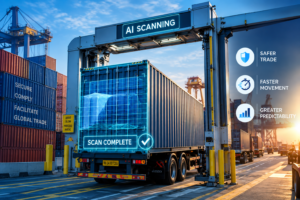
Artificial Intelligence (AI) is not attempting to replace freight forwarders or rebuild the logistics ecosystem from scratch. Instead, it is helping ports, carriers, terminal operators, and logistics providers optimize the operations that determine speed, cost, and reliability.
For businesses involved in freight forwarding, LCL consolidation, international shipping, and supply chain management, this marks the beginning of a new era—one where operational intelligence becomes the industry’s greatest competitive advantage.
Why the First Wave of Logistics Digitalization Fell Short
The first wave of logistics technology was built on a marketplace model.
The objective was to connect shippers and transport providers through digital platforms, making freight booking as simple as ordering food online.
While the concept attracted enormous investment, it underestimated the realities of the logistics industry.
Unlike consumer businesses, freight forwarding depends on far more than transactions. Every shipment requires coordination between carriers, customs authorities, container freight stations, warehouses, transport operators, and multiple regulatory agencies.
Success depends on documentation, compliance, exception management, relationship building, and operational execution.
Freight rates also fluctuate constantly based on market conditions, customer contracts, equipment availability, and vessel capacity. Large exporters and importers negotiate directly with shipping lines, leaving limited room for standardized marketplace pricing.
As a result, many digital freight platforms discovered that digitizing bookings alone could not solve the industry’s deeper operational challenges.
The lesson was clear:
Technology can improve logistics, but only when it enhances operational excellence rather than trying to replace it.
AI Is Solving the Problems Digital Platforms Couldn’t
Artificial Intelligence represents a fundamentally different approach.
Rather than sitting above the logistics ecosystem as another booking platform, AI works within existing operations to improve planning, forecasting, scheduling, and decision-making.
It helps logistics providers answer critical questions before problems occur:
- Which vessels are likely to arrive late?
- How should container yards be organized to reduce congestion?
- Which shipments should be consolidated for maximum efficiency?
- How can empty container movements be minimized?
- Which transport routes will experience delays?
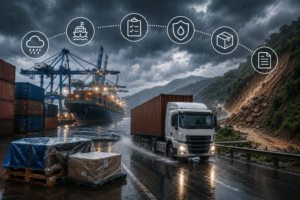
Instead of reacting to disruptions, AI enables organizations to anticipate them.
This shift from reactive logistics to predictive logistics is one of the most significant transformations the industry has witnessed in decades.
Smart Ports: Where AI Is Delivering Measurable Results
Perhaps the clearest evidence of AI’s impact can be seen in the world’s leading ports.
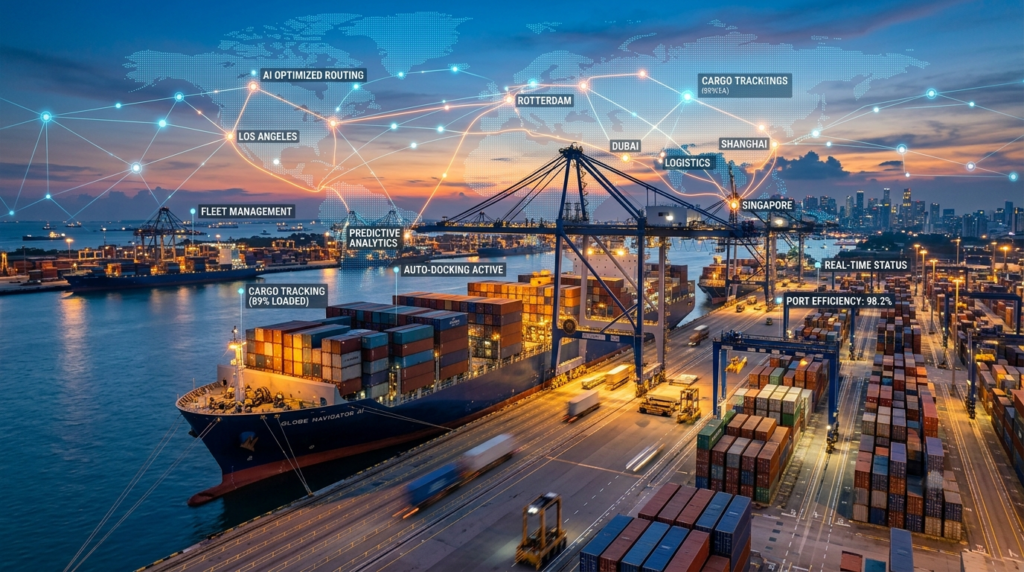
The Port of Rotterdam has become a benchmark for AI-driven port operations through its use of digital twin technology. Every vessel movement is simulated before arrival, allowing operators to optimize berth allocation, reduce waiting times, and minimize fuel consumption by enabling ships to arrive just in time rather than anchoring offshore.
Meanwhile, ports across Singapore, China, and South Korea are integrating AI with private 5G networks to create real-time digital visibility across container terminals. Containers can now be monitored continuously from gate entry to final dispatch, improving accuracy, throughput, and operational efficiency.
These developments demonstrate an important shift in logistics strategy.
The most successful organizations are no longer investing solely in physical infrastructure. They are investing in intelligent infrastructure.
How Shipping Lines Are Using AI to Improve Global Trade
AI adoption is no longer limited to ports.
Leading shipping companies are integrating artificial intelligence into their global operations to improve efficiency across every stage of the supply chain.
For example, CMA CGM has announced strategic AI initiatives to enhance predictive maintenance, optimize container utilization, improve arrival time estimates, and increase the efficiency of yard and crane operations.
These applications deliver tangible benefits:
- Reduced vessel idle time
- Better equipment utilization
- More accurate delivery schedules
- Lower fuel consumption
- Faster cargo handling
For freight forwarders, these improvements translate into greater schedule reliability and improved visibility for customers.
The Rise of AI-Powered Cargo Consolidation
One of AI’s most promising applications lies in cargo consolidation.
Traditionally, LCL (Less than Container Load) consolidation has relied heavily on manual planning and operational experience. Consolidators must determine how to maximize container utilization while balancing cargo compatibility, transit times, destinations, and customer commitments.
AI significantly enhances this process.
By analyzing shipment data in real time, AI can identify optimal consolidation opportunities, predict cargo flows, and recommend container loading strategies that maximize utilization while minimizing costs.
The result is:
- Higher container fill rates
- Reduced empty space
- Lower transportation costs
- Faster shipment planning
- Improved profitability
For exporters and importers, this means more efficient international shipping and greater flexibility in moving smaller consignments.
India’s AI Logistics Journey Has Already Begun
India is entering this transformation from a position of strength.
Over the past decade, major infrastructure initiatives have significantly improved the country’s logistics ecosystem, reducing logistics costs as a percentage of GDP and strengthening multimodal connectivity.
The next phase focuses on intelligence rather than infrastructure alone.
Indian ports are increasingly adopting AI-enabled systems for vessel traffic management, terminal operations, and performance benchmarking. Private investments in automation, predictive analytics, and digital infrastructure are also accelerating across the logistics sector.
This evolution reflects an important reality.
Future competitiveness will depend not only on building new ports, warehouses, and transport corridors, but also on extracting greater efficiency from the assets that already exist.
Why AI Won’t Replace Freight Forwarders
One of the most common misconceptions surrounding AI is that it will eliminate the role of logistics professionals.
The opposite is more likely.
Freight forwarding is built on relationships, regulatory expertise, documentation, problem-solving, and exception management—areas where human judgment remains indispensable.
AI does not replace these capabilities.
Instead, it strengthens them by automating repetitive tasks, identifying operational risks earlier, and providing better decision support.
This enables logistics professionals to focus on strategic planning, customer service, and complex supply chain management rather than manual administration.
In the future, the most successful freight forwarders will not be those competing against AI.
They will be those working alongside it.
What Logistics Companies Should Do Next
The shift toward AI is already underway, but technology alone is not enough.
To realize meaningful results, logistics organizations should focus on several priorities:
- Integrate AI into operational workflows rather than isolated pilot projects.
- Build interoperable data systems that enable seamless information sharing across ports, carriers, warehouses, and customs authorities.
- Invest in workforce development so employees can effectively use AI-driven tools.
- Prioritize predictive planning over reactive problem-solving.
- Use AI to optimize cargo consolidation, routing, and resource utilization instead of simply automating existing processes.
Organizations that combine technology with operational expertise will be best positioned to capture long-term competitive advantages.
The Future of Freight Forwarding Will Be Defined by Intelligence
The logistics industry has experienced many technological milestones—from containerization to GPS tracking and digital documentation.
Artificial Intelligence represents the next major evolution.
Unlike previous digital initiatives, AI is not attempting to replace the industry’s foundations.
It is strengthening them.
By reducing congestion, improving cargo consolidation, optimizing port operations, and enabling predictive supply chain management, AI is helping logistics providers deliver faster, more efficient, and more resilient services.
For freight forwarders, the opportunity extends beyond technology adoption.
It lies in becoming trusted partners capable of combining operational excellence with intelligent decision-making.
Operational Excellence Will Define the Next Generation of Logistics
The first wave of digital transformation focused on simplifying transactions.
The second wave is transforming operations.
That distinction matters.
Because in logistics, sustainable competitive advantage has never come from booking shipments faster.
It has always come from moving cargo more efficiently, responding to disruptions more intelligently, and creating supply chains that remain resilient under pressure.
Artificial Intelligence is making all three possible.
The organizations that embrace this shift today will define the future of freight forwarding tomorrow.
Partner With a Logistics Provider That Combines Experience With Innovation
As global trade becomes increasingly complex, businesses need logistics partners that offer more than transportation.
They need expertise, visibility, and intelligent supply chain solutions.
Whether you’re looking to optimize international shipping, improve cargo consolidation, streamline freight forwarding, or build a more resilient supply chain, our team is ready to help.
Connect with us today to discover how smarter logistics solutions can drive greater efficiency, lower costs, and long-term business growth.