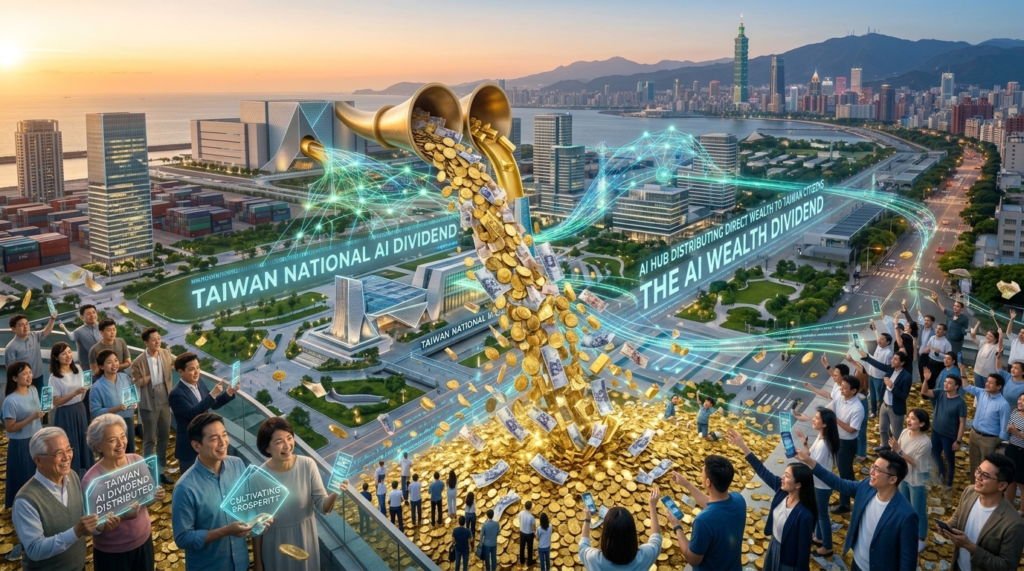
What if the artificial intelligence boom became so profitable that a country could share its economic gains directly with its citizens?
That is the idea behind an extraordinary development in Taiwan.
In August 2026, Taiwan’s government outlined plans for a universal cash payment of NT$10,000—approximately US$314 per eligible recipient—as part of its 2027 fiscal plans. The proposed allocation of NT$235.7 billion, or approximately US$7.4 billion, comes against a backdrop of exceptional economic growth driven by global demand for artificial intelligence infrastructure.
What makes this story remarkable is not simply the proposed payment.
It is how Taiwan created the economic conditions to contemplate it.
The island did not discover oil, uncover vast mineral deposits or suddenly acquire a new natural resource. Instead, it spent four decades developing a manufacturing capability that the world now depends on.
Taiwan built the semiconductor supply chain. The AI revolution made that supply chain extraordinarily valuable. And now the country is looking at how to distribute some of the resulting prosperity.
For anyone involved in international trade, freight forwarding, electronics manufacturing or global supply-chain management, Taiwan’s story offers a powerful lesson.
The greatest economic rewards do not always come from controlling natural resources. Increasingly, they come from controlling capabilities that the rest of the world cannot easily replicate.
How Taiwan Became the Manufacturing Backbone of the AI Economy
When people discuss artificial intelligence, the conversation usually revolves around companies developing AI models, software platforms and applications.
But behind every AI breakthrough lies an enormous physical infrastructure.
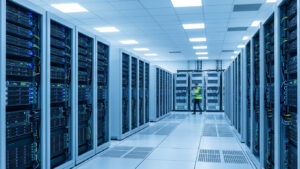
Advanced processors must be manufactured. Servers must be assembled. Data centres require cooling equipment, networking systems, power electronics and sophisticated circuit boards. Semiconductor manufacturing itself depends on highly specialised machinery, chemicals and materials sourced from multiple countries.
And a remarkable proportion of this ecosystem depends on Taiwan.
Taiwan Semiconductor Manufacturing Company (TSMC) manufactures many of the world’s most advanced processors. Other Taiwanese companies produce AI servers, networking equipment, substrates, printed circuit boards, cooling systems and power-management components.
This means Taiwan’s influence extends far beyond semiconductor fabrication.
It occupies a critical position across the global AI hardware supply chain.
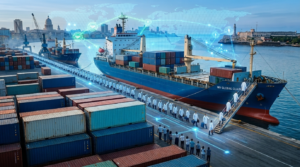
For freight forwarders, this is particularly significant because artificial intelligence is not simply a digital industry.
It is also a physical trade industry.
Every expansion in AI computing capacity creates demand for international movement of semiconductor equipment, electronic components, servers, cooling systems and supporting infrastructure.
And Taiwan sits at the centre of much of that activity.
The 40-Year Industrial Strategy Behind Taiwan’s AI Success
Taiwan’s position in the global semiconductor industry did not emerge overnight.
Its foundations were laid in the 1980s, when the country began investing strategically in semiconductor education, engineering capabilities and advanced manufacturing infrastructure.
TSMC was established in 1987 with government backing and developed a business model that would eventually transform the global electronics industry.
Rather than designing and selling its own chips, TSMC focused on manufacturing semiconductors for other companies.
That specialisation allowed technology companies to concentrate on chip design while relying on Taiwan’s increasingly sophisticated manufacturing capabilities.
Over time, an entire ecosystem developed around the company.
Equipment suppliers, component manufacturers, engineering specialists, materials providers and logistics networks became part of a highly interconnected industrial cluster.
The advantage was cumulative.
Each generation of manufacturing investment created new expertise. Each technological improvement strengthened Taiwan’s competitive position. Each new customer brought additional scale.
By the time the artificial intelligence boom accelerated, Taiwan had already built capabilities that would take competitors years—and enormous investment—to reproduce.
Taiwan’s biggest advantage was not that it predicted the AI boom perfectly. It was that it had spent decades building the infrastructure needed when the boom arrived.
The Numbers Behind Taiwan’s AI Windfall
The economic results have been extraordinary.
Taiwan’s economy reportedly expanded by 15.43% in the first quarter of 2026 and 12.93% in the second quarter, reflecting exceptional demand from technology-related industries.
TSMC’s reported second-quarter revenue reached approximately US$40.2 billion, representing year-on-year growth of 33.7%.
The company also projected that its full-year 2026 revenue could grow by slightly more than 40% in US dollar terms, while increasing planned capital expenditure to between US$60 billion and US$64 billion.
High-performance computing, which includes AI-related applications, accounted for approximately 66% of TSMC’s revenue.
These numbers demonstrate how demand for AI computing is translating into real manufacturing activity.
More advanced chips require more fabrication capacity.
More fabrication capacity requires equipment, materials and infrastructure.
More AI processors require servers, networking systems, cooling equipment and data centres.
And all of this generates activity across international supply chains.
For Taiwan, the economic impact has also strengthened public finances, with projected central government revenue for fiscal year 2027 reaching NT$3.93 trillion.
The proposed cash distribution is therefore being presented as a way to share some of the benefits of the country’s technology-driven expansion.
There is, however, an important distinction: the payment is a fiscal policy proposal funded through government resources, not a direct dividend from TSMC to citizens. Its final implementation and economic effects depend on the relevant budgetary and administrative decisions.
Why Taiwan’s AI Dividend Is More Than a Cash Payment
A payment of approximately US$314 may not fundamentally change a household’s financial position.
But the broader economic message is significant.
Taiwan’s government is effectively recognising that the extraordinary wealth generated by a strategically important industry should benefit more than the companies and shareholders directly involved.
Semiconductor manufacturers generate profits. Their employees receive wages. Investors benefit from rising valuations. Suppliers gain new business.
The proposed distribution seeks to extend part of that benefit to the wider population.
This raises a question that governments around the world are increasingly confronting.
When artificial intelligence creates extraordinary economic value, how should that value be distributed?
The answer matters because the AI revolution may produce uneven economic outcomes.
Countries with advanced semiconductor manufacturing capabilities could capture substantial industrial value. Countries primarily consuming AI technologies may benefit from productivity improvements but capture a different share of the underlying manufacturing profits.
Taiwan’s experience illustrates how the location of critical production capabilities can influence the distribution of economic benefits.
What Taiwan, Singapore and Estonia Reveal About Economic Competitiveness
Taiwan’s experience also raises a broader debate about taxation, industrial policy and the role of government in creating long-term economic prosperity.
Different countries have adopted very different approaches.
Denmark, France, Japan and Austria have relatively high top personal income tax rates. These systems support varying combinations of public healthcare, education, pensions, social security and other services.
Singapore has built its reputation around a competitive business environment, strategic public investment and substantial national financial reserves.
Estonia has emphasised a relatively simple corporate tax structure that generally taxes profits when distributed rather than when retained and reinvested.
These models cannot be reduced to a simple conclusion that lower taxes always produce better economic outcomes.
High-tax economies can deliver strong productivity, public services and quality of life. Lower-tax economies can attract investment but still face challenges involving inequality, infrastructure and public expenditure.
The more relevant lesson from Taiwan is that economic competitiveness depends on how effectively a country combines taxation, investment, industrial capability and long-term planning.
For international businesses, these decisions influence where factories are built, where capital flows, where skilled workers relocate and how global supply chains evolve.
Tax policy and industrial strategy are therefore not abstract economic issues.
They help determine the future geography of global trade.
The Supply Chain Behind Taiwan’s Semiconductor Dominance
Taiwan’s semiconductor success offers another important insight.
No advanced chip reaches the market through the efforts of a single company.
Semiconductor manufacturing depends on an intricate international network of suppliers and specialised logistics operations.
Manufacturing equipment may originate in different countries. Chemicals and precision materials must meet strict quality requirements. Electronic components move between manufacturing facilities, assembly operations and customers.
Finished chips may then travel to other locations for packaging, testing or integration into larger systems.
Those systems eventually become part of servers, smartphones, industrial machinery, vehicles and AI data centres.
The entire process depends on reliable international transportation.
This is where freight forwarding becomes a critical enabler of advanced manufacturing.
The most sophisticated manufacturing facility cannot operate efficiently if essential materials arrive late, equipment is damaged in transit or customs delays interrupt production schedules.
In high-value technology supply chains, logistics reliability is not merely an operational convenience.
It is part of manufacturing competitiveness.
Why AI Growth Is Creating New Opportunities for Freight Forwarding
The rapid expansion of artificial intelligence infrastructure is generating demand across several categories of international freight.
Semiconductor manufacturing equipment can require specialised handling, secure transportation and complex project logistics.
Electronic components often require careful packaging, traceability and dependable delivery schedules.
AI servers and networking equipment represent high-value cargo where transit reliability and security are particularly important.
Cooling systems, power infrastructure and data-centre equipment create additional demand for conventional container shipping, air freight and project cargo services.
As investment in AI infrastructure expands across countries, these cargo flows are likely to become increasingly important to global logistics networks.
The opportunity is not limited to moving finished electronics.
It extends across the entire manufacturing ecosystem.
And because these supply chains involve multiple countries and suppliers, freight forwarders with strong international networks, documentation expertise and multimodal capabilities become increasingly valuable.
The Role of LCL Consolidation in the Global Electronics Supply Chain
Not every company participating in the semiconductor and AI hardware ecosystem ships full containers.
A specialised manufacturer may need to move a relatively small quantity of electronic components.
An equipment supplier may ship replacement parts.
A distributor may import multiple consignments from different manufacturers.
An industrial customer may require smaller, more frequent deliveries to avoid tying up working capital in inventory.
For these businesses, Less than Container Load (LCL) consolidation can offer a practical alternative to booking an entire container.
LCL allows multiple smaller shipments to share container capacity, potentially making international ocean freight more economical for businesses that do not have sufficient volume for FCL shipments.
But electronics supply chains place particular demands on consolidation quality.
Accurate documentation, cargo compatibility, careful handling, reliable sailing schedules and efficient destination deconsolidation all matter.
Sensitive or high-value electronic components may also require packaging and handling precautions beyond those used for general cargo.
The choice between LCL, FCL and air freight therefore depends on more than shipment size.
It requires an assessment of cargo value, sensitivity, urgency, transit time and the commercial consequences of delay.
The most economical freight solution is not always the one with the lowest transportation rate. It is the one that balances freight cost with inventory, reliability and business risk.
Taiwan’s Greatest Strength Is Also Its Biggest Supply Chain Risk
There is another side to Taiwan’s remarkable success.
Economic concentration creates vulnerability.
TSMC represents a substantial proportion of Taiwan’s stock-market value, and the broader economy has become deeply exposed to global semiconductor demand.
As long as demand for advanced chips continues expanding, this concentration can generate exceptional returns.
But what happens if demand slows?
What happens if AI infrastructure spending becomes more cautious, export restrictions tighten or competing semiconductor manufacturers gain technological ground?
The same concentration that created Taiwan’s economic windfall could amplify the impact of a downturn.
There is also geopolitical risk.
Taiwan occupies a strategically sensitive position in East Asia, making its semiconductor industry a major consideration in global economic-security discussions.
For companies dependent on Taiwanese technology, the issue is not whether Taiwan is an efficient supplier.
It clearly is.
The issue is whether an efficient supply chain is necessarily a resilient one.
Those are not always the same thing.
Why Global Semiconductor Supply Chains Need Diversification
Taiwan’s dominance illustrates a challenge facing many modern industries.
Over time, manufacturing tends to concentrate where the strongest capabilities, supplier networks and economies of scale exist.
That concentration creates efficiency.
But it can also create systemic risk.
If a critical supplier, manufacturing region or transportation corridor becomes unavailable, businesses may discover that alternatives are limited.
This is one reason countries are investing in domestic semiconductor capabilities and seeking to diversify critical technology supply chains.
However, diversification is easier to discuss than execute.
Advanced semiconductor manufacturing requires extraordinary capital investment, specialised talent, technological expertise and reliable supporting infrastructure.
Building a new factory does not automatically recreate the supplier ecosystem that developed around Taiwan over decades.
The lesson for supply-chain professionals is therefore clear.
Diversification requires more than identifying another supplier. It requires understanding whether the alternative ecosystem can actually deliver.
That includes manufacturing capacity, technical capability, logistics connectivity, quality standards and delivery reliability.
What Taiwan’s AI Success Means for India
India’s semiconductor ambitions make Taiwan’s story especially relevant.
Through industrial policies and incentive programmes, India is seeking to strengthen its position in electronics manufacturing, semiconductor production and advanced technology infrastructure.
The Tata-PSMC semiconductor fabrication project in Dholera, Gujarat, represents one of the country’s significant investments in building domestic semiconductor manufacturing capability.
But Taiwan’s experience shows why this journey requires patience.
Its current position was built over approximately four decades.
That development involved sustained investment in education, research, manufacturing facilities, supplier ecosystems and industrial expertise.
India’s opportunity therefore extends beyond establishing individual semiconductor factories.
The larger challenge is to develop an interconnected manufacturing ecosystem capable of supporting them.
This includes precision engineering, materials, specialised equipment, testing, packaging, electronics assembly and the logistics infrastructure needed to connect these activities with global markets.
India’s long-term advantage will depend on whether these investments develop into internationally competitive industrial capabilities.
The important question is not simply how many semiconductor facilities India builds today.
It is what position India can establish in the global technology supply chain over the next 20 to 30 years.
Why India’s Logistics Infrastructure Will Matter to Its Semiconductor Ambitions
Manufacturing competitiveness is closely linked to logistics competitiveness.
Advanced industries need dependable access to imported equipment and materials, efficient customs processes, reliable domestic transportation and predictable international connectivity.
For India’s semiconductor and electronics ambitions, these requirements will become increasingly important.
Factories cannot afford frequent interruptions caused by delayed inputs.
High-value equipment requires appropriate handling.
Export-oriented manufacturing needs dependable access to international markets.
And companies participating in global production networks must be able to coordinate shipments across multiple suppliers and locations.
This creates an important opportunity for India’s freight forwarding industry.
As the country’s advanced manufacturing ecosystem expands, logistics providers will need to support increasingly sophisticated cargo movements through a combination of ocean freight, air freight, project logistics, customs coordination and specialised transportation.
For smaller manufacturers and component suppliers, reliable LCL consolidation services can also provide access to international trade networks without requiring full-container shipment volumes.
The growth of India’s semiconductor industry will therefore depend not only on technology investment but also on the quality of the supply chains supporting it.
Can Taiwan’s AI Dividend Model Be Replicated?
Taiwan’s experience is compelling, but it is not a formula that other countries can simply copy.
Its economic windfall reflects a specific combination of industrial policy, technological capability, global demand and historical timing.
The semiconductor investments made decades ago positioned Taiwan to benefit from a technology revolution that few could have predicted in its current form.
Other countries may not have the same capabilities or fiscal circumstances.
There are also limits to what a one-time cash distribution can achieve.
It may provide immediate household support and allow citizens to participate more visibly in economic growth.
But it cannot, by itself, resolve structural challenges involving housing affordability, wages, demographic pressures or industrial concentration.
Similarly, the economic effects of cash transfers depend on their funding, scale and broader economic conditions. A government-financed distribution does not automatically create the same inflationary pressures as monetary expansion, but its impact on consumption and prices cannot be dismissed entirely.
The deeper lesson is therefore not that every country should introduce an AI dividend.
It is that long-term industrial capability can create economic opportunities that short-term fiscal measures alone cannot produce.
The Real Lesson: Build What the World Will Need Tomorrow
Taiwan’s semiconductor success offers a valuable perspective on the relationship between industrial strategy and global trade.
The country invested in an industry long before artificial intelligence became a defining technology.
It built expertise, attracted customers, developed supplier networks and continuously upgraded manufacturing capabilities.
When global demand changed, Taiwan was prepared.
That preparation created enormous economic value.
The proposed AI dividend is one possible way of distributing part of that value, but the more important achievement happened decades earlier.
Taiwan built something the world needed.
And it built it exceptionally well.
For India and other emerging manufacturing economies, the challenge is to identify which capabilities will become indispensable in the decades ahead.
For businesses, the lesson is equally important.
Competitive advantage increasingly comes from controlling critical capabilities, developing reliable supplier networks and investing before demand becomes obvious.
And for the logistics industry, Taiwan demonstrates that every major manufacturing revolution creates an equally important supply-chain transformation.
Advanced chips may power artificial intelligence.
But international trade, freight forwarding and logistics networks help make their production and global distribution possible.
The Next Economic Dividend Will Be Built on Today’s Supply Chains
The artificial intelligence boom is often described as a technological revolution.
Taiwan demonstrates that it is also an industrial and economic revolution.
Behind the algorithms are factories.
Behind the factories are suppliers.
Behind the suppliers are international trade networks.
And connecting them all are logistics systems that allow components, equipment and finished products to move across borders.
Countries that develop the right capabilities today may capture extraordinary economic value tomorrow.
But those capabilities must be supported by resilient infrastructure, skilled people and efficient supply chains.
Taiwan’s story ultimately leaves us with a question that every government and business should consider:
What are we building today that the world will depend on 30 years from now?
Because the next great economic windfall may not come from discovering a new resource.
It may come from developing a capability so valuable that the world cannot function without it.
And when that happens, logistics will be one of the systems that makes the opportunity possible.
Building Supply Chains for the Industries of Tomorrow
As artificial intelligence, semiconductor manufacturing and advanced electronics reshape international trade, businesses need freight partners capable of managing increasingly complex global supply chains.
At Global Logistics, we support importers and exporters through international freight forwarding, LCL consolidation, FCL, air freight and project cargo solutions.
From smaller component shipments to complex international cargo movements, our focus is on helping businesses maintain reliable connectivity across global markets.
Connect with Global Logistics to explore efficient, dependable freight solutions for your international supply chain.