
For more than three decades, global supply chains followed a simple rule: manufacture where costs were lowest.
That strategy transformed China into the world’s manufacturing powerhouse and enabled businesses to optimize production costs like never before. Companies built lean, globally integrated supply chains that prioritized efficiency above all else.
Today, that model is being fundamentally redefined.
The question dominating boardrooms is no longer, “Where can we manufacture most cheaply?” Instead, executives are asking a far more strategic question:
Where can we manufacture most safely, reliably, and sustainably?
The answer is driving one of the biggest shifts in global trade since the rise of globalization itself.
Companies are investing trillions of dollars in relocating manufacturing, redesigning sourcing strategies, and creating more resilient supply chains through two powerful approaches: nearshoring and friendshoring.
Although these terms are often used interchangeably, they represent two very different supply chain strategies. Understanding the distinction is critical for manufacturers, importers, exporters, and logistics providers navigating today’s increasingly complex trade environment.
Nearshoring vs. Friendshoring: Understanding the Difference
At first glance, both strategies involve moving production away from traditional manufacturing hubs. However, the motivations behind them are fundamentally different.
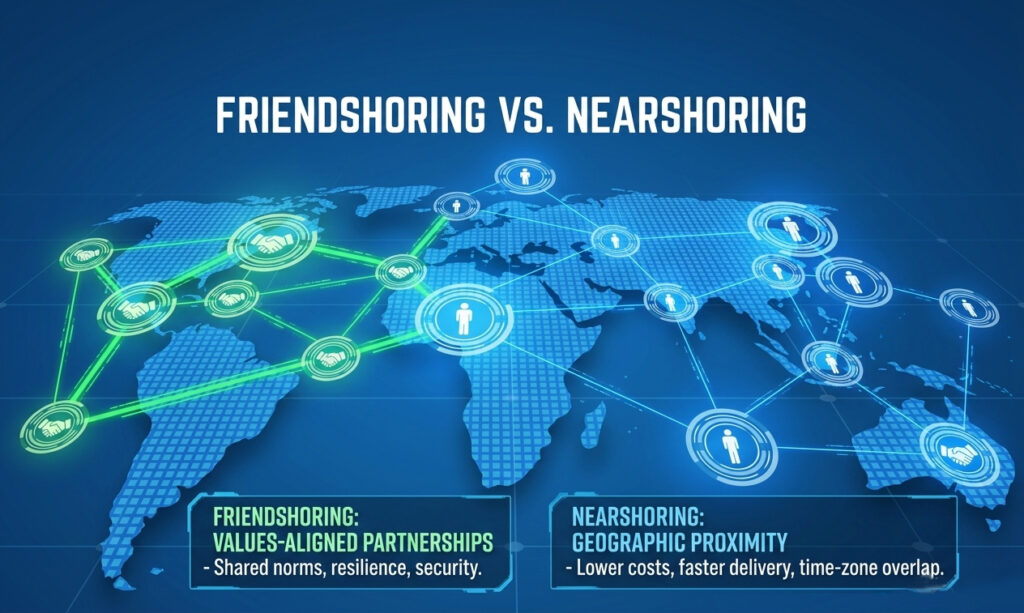
Nearshoring is driven by geography.
Companies relocate production closer to their primary consumer markets to shorten supply chains, reduce transportation costs, improve delivery speeds, and gain better visibility over operations. A European manufacturer shifting production to Poland or a U.S. company expanding manufacturing in Mexico are classic examples of nearshoring.
Friendshoring, on the other hand, is driven by geopolitics.
Rather than focusing on proximity, companies prioritize countries with stable diplomatic relationships, reliable trade agreements, and lower geopolitical risk. A manufacturer sourcing components from India instead of China, or a European company shifting procurement from Russia to Norway, reflects a friendshoring strategy.
While one prioritizes operational efficiency, the other prioritizes supply chain resilience.
Both, however, are responses to the same reality: the traditional model of highly concentrated global manufacturing has proven increasingly vulnerable.
Why Companies Are Moving Away from Single-Country Supply Chains
Over the past five years, global businesses have experienced an unprecedented series of disruptions.
The COVID-19 pandemic exposed the fragility of highly centralized supply chains. Trade tensions between the United States and China altered sourcing decisions. The Russia–Ukraine conflict disrupted energy markets and commodity flows. Security concerns in the Red Sea forced shipping lines to reroute vessels, extending transit times and increasing freight costs.
These events fundamentally changed how companies evaluate risk.
Supply chain resilience has evolved from an operational consideration into a boardroom priority.
Organizations are increasingly recognizing that concentrating production in a single geography creates unnecessary exposure to geopolitical uncertainty, transportation disruptions, and regulatory changes.
As a result, businesses are diversifying manufacturing locations, supplier networks, and logistics strategies to reduce dependency on any one market.
This shift represents more than a temporary adjustment—it marks a structural transformation in global trade.
The $4.7 Trillion Investment Reshaping Manufacturing
The scale of this transformation is extraordinary.
Large organizations across North America and Europe are projected to commit approximately $4.7 trillion toward nearshoring and reshoring initiatives over the next few years. These investments are funding new manufacturing facilities, supplier ecosystems, logistics infrastructure, and regional distribution networks.
At the same time, businesses are increasingly embracing friendshoring as a long-term strategy to strengthen supply chain resilience.
This isn’t simply about relocating factories.
It involves redesigning entire supply chain ecosystems—from sourcing and production to transportation and distribution.
For freight forwarders and logistics providers, this creates significant opportunities as new trade corridors emerge and cargo flows shift across regions.
The Countries Emerging as the Biggest Winners
As manufacturing networks diversify, several countries are positioning themselves as key beneficiaries of this new supply chain architecture.
Mexico: North America’s Nearshoring Powerhouse
Mexico has become one of the strongest beneficiaries of nearshoring, driven largely by its geographic proximity to the United States and preferential trade access under regional agreements.
Manufacturers are increasingly viewing Mexico as more than a low-cost production base. Investments are flowing into advanced manufacturing, electronics, automotive production, and semiconductor-related industries.
This shift is transforming the country into a strategic manufacturing hub capable of supporting increasingly sophisticated global supply chains.
For logistics providers, growing trade between Mexico and the United States is generating higher demand for integrated freight forwarding, customs brokerage, cross-border transportation, and multimodal logistics services.
Vietnam: A Preferred Destination for Friendshoring
Vietnam has emerged as one of Asia’s fastest-growing manufacturing economies.
Global electronics companies have significantly expanded production capabilities in the country, helping establish Vietnam as an important alternative manufacturing destination.
Its combination of political stability, competitive labor costs, and export-oriented industrial policies has attracted substantial foreign investment across electronics, consumer goods, and technology manufacturing.
As production expands, so does the need for efficient ocean freight, LCL consolidation, warehousing, and international shipping solutions.
India: Building Long-Term Manufacturing Strength
India is increasingly being viewed as a strategic long-term manufacturing partner.
Government initiatives supporting domestic manufacturing, combined with investments in electronics, automotive production, textiles, and semiconductor ecosystems, are strengthening India’s position within global supply chains.
At the same time, improvements in transport infrastructure, port modernization, dedicated freight corridors, and multimodal logistics networks are enhancing the country’s competitiveness.
For freight forwarders, India’s growing manufacturing base presents opportunities to develop stronger export networks, expand LCL consolidation services, and support businesses entering global markets.
The Challenges Behind Supply Chain Diversification
Despite the optimism surrounding nearshoring and friendshoring, relocating manufacturing is far from straightforward.
One of the biggest obstacles is workforce capability.
Establishing new factories is significantly easier than replicating decades of manufacturing expertise. Many countries continue to face shortages of skilled labor capable of supporting advanced industrial production.
Infrastructure also remains a challenge.
Manufacturing investment often arrives faster than supporting logistics infrastructure. Ports, highways, rail networks, warehousing facilities, and inland transportation systems require substantial investment to accommodate rising trade volumes efficiently.
Another important consideration is geopolitical uncertainty itself.
Trade policies, tariffs, and international relations continue to evolve rapidly, making long-term investment decisions increasingly complex.
Supply chains designed for resilience must therefore remain flexible enough to adapt to changing economic and political conditions.
How Freight Forwarding Is Becoming More Strategic
As manufacturing networks become increasingly distributed, logistics grows more complex.
Instead of moving cargo between a limited number of established trade lanes, freight forwarders are now coordinating shipments across multiple sourcing locations, regional manufacturing hubs, and diversified supplier ecosystems.
This evolution requires far more than transportation expertise.
Modern freight forwarding increasingly depends on:
- End-to-end supply chain visibility
- Multimodal transportation planning
- Customs and regulatory expertise
- Digital shipment tracking
- Risk management and contingency planning
- Efficient LCL (Less than Container Load) consolidation
Rather than simply moving cargo, freight forwarders are becoming strategic partners that help businesses build resilient, adaptable supply chains.
Why LCL Consolidation Matters More Than Ever
Supply chain diversification is also changing shipment patterns.
Instead of importing large volumes from a single country, many businesses are sourcing smaller quantities from multiple regions.
This makes LCL consolidation increasingly valuable.
By combining smaller shipments into shared containers, businesses can:
- Reduce transportation costs
- Improve inventory flexibility
- Enter new sourcing markets without requiring full-container volumes
- Respond more quickly to demand fluctuations
As trade becomes more regionalized and diversified, LCL consolidation offers the agility businesses need to remain competitive.
The Future of Global Trade Will Be Defined by Resilience
Globalization is not disappearing.
International trade continues to grow, but its structure is changing.
Instead of relying on a single dominant manufacturing hub, businesses are creating geographically diversified, politically resilient, and operationally flexible supply chains.
Cost remains important.
But today, it is balanced against other critical factors:
- Geographic proximity
- Political stability
- Infrastructure readiness
- Workforce capability
- Logistics efficiency
- Supply chain resilience
These dimensions are rapidly becoming the new framework for global competitiveness.
The Winners Will Build Supply Chains for Tomorrow, Not Yesterday
Nearshoring and friendshoring are not temporary responses to recent disruptions.
They represent a long-term reconfiguration of global manufacturing and trade.
Countries investing in infrastructure, workforce development, and logistics capabilities are positioning themselves to capture the next generation of industrial investment.
For businesses, success will depend on building supply chains that balance efficiency with resilience.
And for logistics providers, the opportunity extends beyond moving cargo.
It lies in helping customers navigate an increasingly complex global trade environment through intelligent freight forwarding, flexible transportation strategies, and efficient cargo consolidation solutions.
The companies that succeed over the next decade won’t necessarily be those with the lowest production costs.
They will be those with supply chains designed to withstand uncertainty while remaining agile enough to seize new opportunities.
Partner With a Logistics Provider Built for the New Era of Global Trade
As manufacturing networks evolve and new trade corridors emerge, businesses need logistics partners who understand changing supply chain dynamics.
Whether you’re expanding into new sourcing markets, optimizing international shipping, leveraging LCL consolidation, or building resilient freight forwarding strategies, our experts can help you stay ahead of global change.
Mail us on [email protected] to discover how intelligent logistics solutions can support your global growth strategy.