
What Happens Behind the Internet? The Hidden Logistics of Global Data Flow
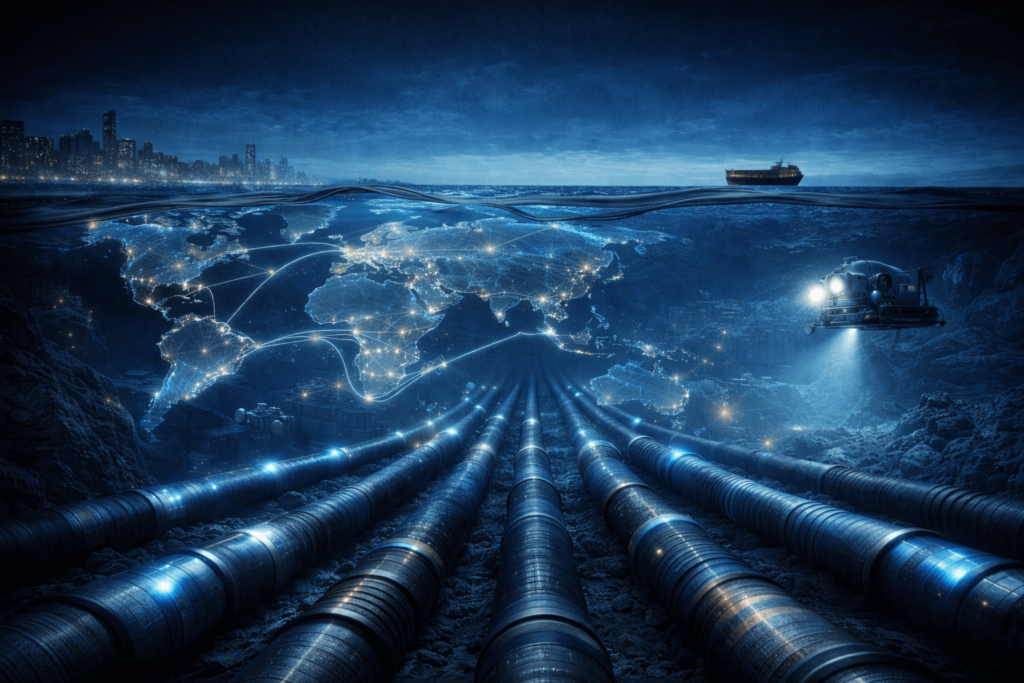
When you stream a video, send an email, or process an international payment, your data isn’t floating through the air. It’s traveling through submarine cables lying thousands of meters below the ocean’s surface.
These undersea fiber-optic cables form the backbone of global digital infrastructure. In fact, 99% of the world’s internet traffic flows through these cables — not satellites. For businesses in freight forwarding, global trade, and LCL consolidation, this invisible network powers everything from shipment tracking to digital documentation and international banking transactions.
Welcome to the world of data logistics — one of the most critical yet least understood supply chains in existence.
The Invisible Backbone of the Global Economy
As of 2025, approximately 570 active submarine cable systems span the oceans, stretching over 1.5 million kilometers — enough to circle the Earth 37 times.
Each modern submarine cable can transmit 200 to 400 terabits per second, while satellites manage less than 1% of global data traffic. To put it into perspective, a single fiber pair can handle the equivalent of 150 million simultaneous phone calls.
The journey began in 1858 when the first transatlantic cable carried a message from Queen Victoria to US President James Buchanan. That cable lasted only three weeks and transmitted one character every two minutes. Today, global banking systems move nearly $3.9 trillion every workday through these digital arteries.
For global logistics companies and freight forwarders, this infrastructure ensures real-time cargo visibility, secure financial transfers, customs documentation processing, and international coordination.
How Data Travels Across Continents
Imagine a business in Mumbai coordinating a shipment to New York. The communication request moves through terrestrial fiber networks to a cable landing station — such as Versova in Mumbai — before entering the submarine cable network.
These cables use Dense Wavelength Division Multiplexing (DWDM) technology, allowing multiple data streams to travel simultaneously through different light wavelengths within a single fiber.
Optical repeaters placed every 50 to 100 kilometers amplify signals, even at depths of 8,000 meters.
In India, 17 international submarine cables land across 16 regions. As of late 2024, India’s submarine cable capacity stood at 193 terabits per second, with 148 Tbps activated — powering connectivity for over 954 million internet users, an 8.3% annual growth.
For international trade and freight forwarding businesses, this connectivity is the backbone of digital trade documentation, online freight bookings, and global shipment management systems.
The Concentration Risk: A Digital Chokepoint
Despite its scale, global data infrastructure faces significant vulnerabilities.
In India, a majority of submarine cables land within a six-kilometer stretch in Versova, Mumbai. This concentration creates systemic risk for a country of 1.4 billion people and a service export economy valued at $341 billion.
Between 2024 and 2025, multiple incidents exposed these vulnerabilities:
- Red Sea cable damage disrupted 70% of Europe-Asia data traffic.
- Baltic Sea cables were severed multiple times, impacting Lithuania’s internet capacity.
- Taiwan experienced four cable disruptions in rapid succession.
- Globally, 150–200 cable outages were reported in 2025 alone.
For industries dependent on digital systems — including logistics and international trade — such disruptions can delay transactions, impact cargo movement, and freeze financial settlements.
India’s Strategic Response: Diversification & Resilience
Recognizing the importance of digital infrastructure, India has accelerated investment in submarine cable expansion and geographic diversification.
Recent projects include:
- 2Africa Pearls – a 45,000 km system connecting 33 countries with 180 Tbps capacity.
- India-Asia-Express (IAX) – strengthening Southeast Asia connectivity.
- India-Europe-Express (IEX) – providing direct European access.
These systems are expected to significantly expand India’s internet capacity.
New landing stations are also being developed beyond Mumbai and Chennai — including locations like Visakhapatnam, Kochi, Trivandrum, and Tuticorin — spreading risk and enhancing resilience.
For businesses in freight forwarding and LCL consolidation, this diversification ensures stronger digital reliability for cross-border coordination, documentation, and payment processing.
The Challenges of Submarine Cable Infrastructure
Building and maintaining submarine cables involves complex logistical challenges:
1. Repair Limitations
India currently lacks its own cable repair ships, relying on international contractors. Global demand for repairs has surged, causing delays.
2. Regulatory Complexities
Laying cables across international waters requires multi-country approvals, often slowing deployment.
3. Aging Infrastructure
Many cables have a 25-year lifespan. Several Indian systems are nearing obsolescence, requiring modernization.
4. Security Risks
Cables remain vulnerable to anchors, fishing activity, natural disasters, and geopolitical tensions.
5. Environmental Considerations
Cable laying must avoid sensitive seabed ecosystems, requiring advanced mapping and environmental safeguards.
The Future of Data Logistics
The global submarine cable market is projected to grow from $31.7 billion in 2024 to $56.9 billion by 2035, reflecting rising demand for data capacity.
Key developments shaping the future include:
Hyperscale Investments
Technology giants such as Google, Meta, Microsoft, and Amazon are heavily investing in cable infrastructure, accounting for billions in new projects between 2024 and 2026.
Space Division Multiplexing (SDM)
This innovation increases fiber efficiency dramatically, enabling higher capacity within the same cable footprint.
SMART Cables
Next-generation cables integrate ocean sensors to monitor seismic activity and climate patterns, combining connectivity with scientific research.
Arctic Routes
New polar cable projects could reduce Asia-Europe latency and create alternative digital corridors.
For India, the submarine cable sector is projected to grow at a CAGR of 19.4%, driven by new island connectivity projects and expanded Southeast Asia and Middle East links.
Why Data Logistics Matters to Freight Forwarders & LCL Consolidators
The logistics industry depends on secure, high-speed digital infrastructure for:
- Real-time shipment tracking
- Electronic bills of lading
- Customs documentation filing
- International payment processing
- Multimodal freight coordination
Submarine cables are the unseen highways enabling global trade to function smoothly.
As digital transformation accelerates across freight forwarding and LCL consolidation services, resilient data infrastructure becomes just as critical as ports, vessels, and warehouses.
The Bottom Line
Every shipment tracked, every invoice processed, every international payment executed — all depend on thin fiber-optic cables lying quietly on the ocean floor.
Digital infrastructure is now economic infrastructure.
For global trade, supply chains, and logistics providers, understanding the logistics behind data flow is essential in a hyper-connected world.
The next time you hear someone say their data is “in the cloud,” remember — it’s actually traveling through one of the world’s most sophisticated logistics networks, deep beneath the sea.