
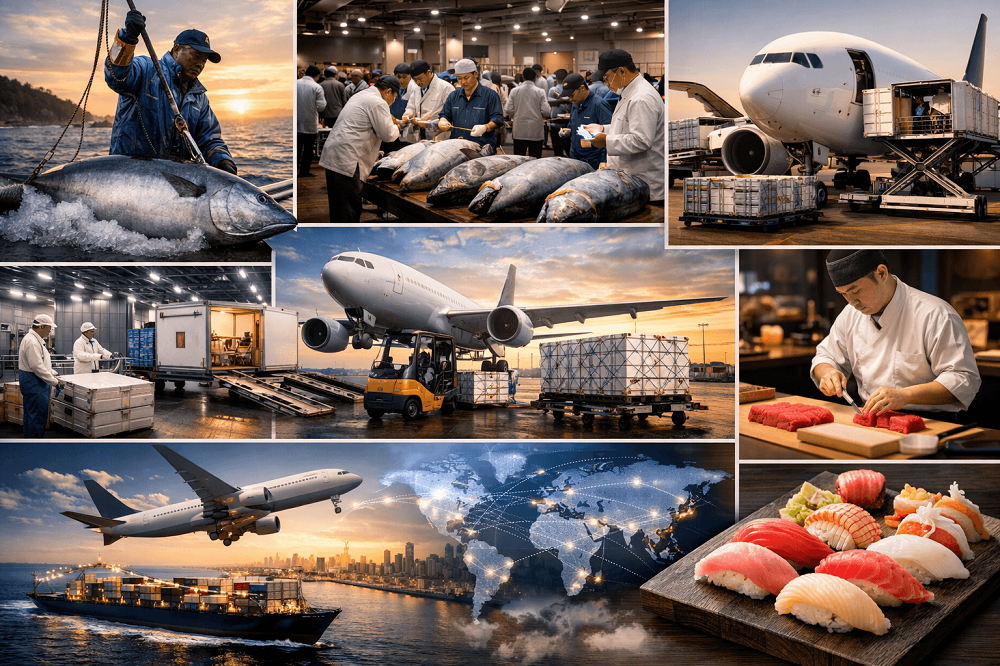
From Ocean to Omakase: The Precision Logistics Behind Global Sushi Supply Chains
Introduction: A Supply Chain Measured in Hours, Not Days
Every morning at 5:30 AM, controlled chaos unfolds at Tokyo’s Toyosu Fish Market—the largest seafood trading hub in the world. Buyers from elite sushi restaurants inspect premium tuna with surgical precision, evaluating texture, fat content, and color before bidding begins.
In January 2026, a single bluefin tuna sold for over $3 million.
But here’s what makes this extraordinary from a logistics perspective: that same fish—or one just like it—can be on a plate in Singapore, Bangkok, or Hong Kong within 24 to 48 hours.
This is not just food distribution. It is one of the most advanced cold chain logistics and freight forwarding ecosystems ever built—where time, temperature, and precision define value.
Why Japan Built the World’s Most Advanced Food Logistics System
To understand the logistics, you first need to understand the philosophy behind it.
In Japan, freshness is not a preference—it is a cultural standard. The concept of shun emphasizes consuming food at its peak seasonal quality. Even a single day’s delay can compromise the dining experience.
This cultural expectation has driven Japan to engineer a logistics system that operates with near-pharmaceutical precision.
Today, Japan’s food logistics industry is a multi-billion-dollar ecosystem powered by:
- Real-time temperature monitoring using IoT sensors
- Automated warehousing and robotic handling systems
- Highly coordinated air freight networks
For logistics professionals, this represents a benchmark—a supply chain designed not for efficiency alone, but for perfection.
The Race Begins at the Source: Fishing, Handling, and First-Mile Logistics
In seafood logistics, quality is determined within minutes of catch—not hours.
Premium fish such as bluefin tuna and sea urchin are handled using a technique called ikejime, which ensures minimal stress and preserves meat quality. This process prevents biochemical degradation that would otherwise reduce the fish’s value significantly.
Once caught, the fish enters a tightly controlled first-mile logistics chain:
- Immediate icing (not freezing) to stabilize temperature
- Rapid transport via refrigerated trucks to ports or markets
- Precise grading based on quality indicators
This early-stage handling is critical. In fact, the first 30 minutes of the supply chain often matter more than the next 30 hours.
For freight forwarders handling perishable cargo, this reinforces a key principle:
quality is created at origin and protected through logistics—not recovered later.
Temperature Is Everything: The Science Behind Sushi Logistics
One of the most misunderstood aspects of seafood logistics is temperature management.
“Fresh” does not always mean “never frozen.” Instead, different logistics strategies are used depending on distance and destination.
For short-haul international shipments, such as those within Asia, seafood is transported chilled at near-zero temperatures. This ensures the fish remains fresh for consumption within a limited time window.
For long-haul global exports, a more advanced method is used—super-freezing. At temperatures as low as -60°C, the fish’s cellular structure is preserved so effectively that it can be thawed without compromising quality.
This distinction allows logistics providers to balance:
- Shelf life
- Transit time
- Market reach
It also highlights the critical role of temperature-controlled freight forwarding and cold chain logistics in high-value cargo movement.
Air Freight & Consolidation: The Backbone of Global Sushi Distribution
The global sushi supply chain relies heavily on air freight—but not in the way most people assume.
While speed is essential, cost optimization is equally critical. This is where consolidation strategies, including LCL principles, play a key role.
Instead of shipping individual orders daily, logistics providers aggregate shipments across multiple buyers and dispatch them every two to three days. This approach ensures:
- Cost efficiency through shared freight space
- Consistent delivery schedules
- Reduced wastage and optimized inventory flow
From a logistics standpoint, this model demonstrates how strategic consolidation can balance speed and cost without compromising quality.
The typical journey involves:
- Origin inspection and certification
- Air freight transport within hours
- Customs clearance at destination
- Refrigerated last-mile delivery
All within a tightly controlled 24–36-hour window.
Global Demand: How Sushi Became a Worldwide Logistics Network
The demand for Japanese seafood has expanded far beyond domestic markets.
Today, premium seafood is shipped globally to meet the needs of:
- High-end restaurants
- International retail chains
- Expanding quick-service sushi brands
This demand has transformed seafood logistics into a truly global operation, with supply chains connecting Japan to Southeast Asia, North America, and beyond.
Interestingly, large restaurant chains are now moving upstream in the supply chain—investing directly in aquaculture and production to ensure consistent quality and supply.
This marks a shift from traditional sourcing to vertically integrated logistics ecosystems.
Supply Chain Resilience: Lessons from the China Disruption
In 2023, a major disruption tested the resilience of Japan’s seafood logistics network when China imposed a ban on Japanese seafood imports.
China had been a key processing hub, particularly for scallops. The sudden disruption forced Japan to rapidly reconfigure its supply chain.
Instead of collapsing, the industry adapted by:
- Redirecting processing to Vietnam, Thailand, and Mexico
- Expanding certification capabilities in new regions
- Leveraging existing cold chain infrastructure
Within months, export volumes recovered.
For logistics professionals, this highlights a critical insight:
resilient supply chains are not fixed—they are designed to adapt.
Key Logistics Lessons from the Sushi Supply Chain
The global sushi supply chain offers powerful lessons for the broader logistics industry.
First, temperature control is not just a compliance requirement—it is a product differentiator. Precision in temperature management directly impacts value.
Second, delivery frequency can be more important than shipment volume. Smaller, frequent shipments often outperform large, infrequent ones in perishable logistics.
Third, origin handling determines final quality. Investments at the source yield greater returns than corrective measures in transit.
Fourth, certifications are essential for market access. Without the right compliance framework, even the best logistics network cannot operate effectively.
Finally, vertical integration is becoming a strategic advantage. Companies that control more of the supply chain gain greater resilience and consistency.
The Future of Cold Chain Logistics: Innovation Meets Sustainability
The next phase of seafood logistics is being shaped by technology and sustainability.
Advancements such as AI-driven monitoring systems and land-based aquaculture are redefining how and where seafood is produced and transported.
At the same time, the industry is moving toward greener logistics solutions, including alternative fuels and energy-efficient cold storage systems.
These developments will not only improve efficiency but also align supply chains with evolving environmental expectations.
Conclusion: The True Value of Precision Logistics
The journey of a single piece of sushi—from ocean to plate—is a masterclass in logistics excellence.
It involves a seamless integration of:
- Time-sensitive freight forwarding
- Advanced cold chain management
- Strategic consolidation
- Global coordination across multiple stakeholders
For logistics companies, the lesson is clear:
The most valuable supply chains are not simply fast or cost-effective. They are engineered around a single, uncompromising standard—and every process is designed to protect it.
In industries where precision, timing, and quality are non-negotiable, your logistics partner makes all the difference.
Whether you’re shipping perishable goods, high-value cargo, or time-sensitive consignments, expertise in freight forwarding, cold chain logistics, and LCL consolidation is essential.
👉 Connect with us to build a high-performance logistics strategy that delivers reliability, efficiency, and global reach.