
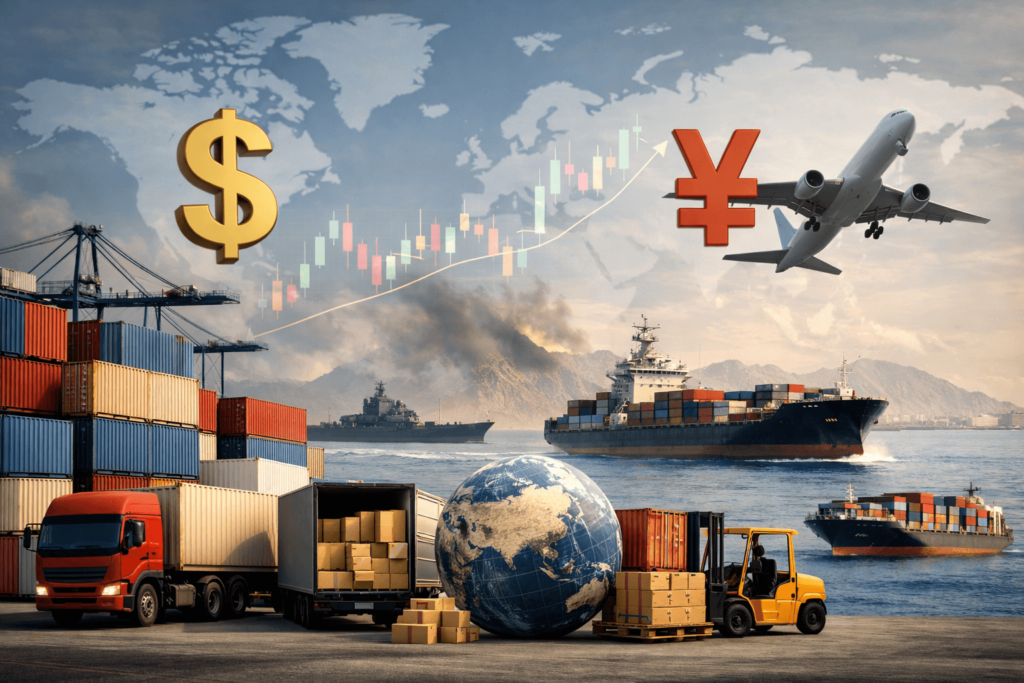
The Iran Crisis, Currency Wars & Global Trade: What It Means for Freight Forwarding and Supply Chains
Introduction: A War That Changed More Than Borders
Most global conflicts disrupt supply chains. Some reshape trade routes. But very few challenge the foundation of global trade itself—the currency system it runs on.
In March 2026, amid escalating tensions in the Iran-Iraq conflict, a seemingly simple proposal sent shockwaves through global markets. Iran signaled that oil tankers could pass through the Strait of Hormuz—but only if transactions were conducted in Chinese yuan instead of US dollars.
At first glance, this appeared to be a geopolitical maneuver. In reality, it represents something far more significant: a potential restructuring of global trade flows, currency systems, and logistics economics.
For businesses involved in freight forwarding, LCL consolidation, and international shipping, this shift is not theoretical—it has direct implications on costs, risk, routing, and financial strategy.
Understanding the Petrodollar System: The Backbone of Global Trade
To understand why this matters, we must revisit the system that has governed global trade for decades.
Since the 1970s, oil—the world’s most traded commodity—has been priced almost exclusively in US dollars. This created a self-reinforcing system where:
- Countries needed dollars to buy oil
- Central banks accumulated dollar reserves
- Global trade settled predominantly in USD
This system, known as the petrodollar, has long supported the stability of international trade, freight payments, and cross-border settlements.
For logistics providers, it meant predictability:
- Freight contracts denominated in USD
- Stable pricing benchmarks
- Standardized global payment systems
But this stability is now being tested.
The Strait of Hormuz: A Logistics Chokepoint Turned Financial Lever
The Strait of Hormuz is not just a geographic passage—it is one of the most critical arteries of global trade.
- Nearly 25% of global seaborne oil passes through it
- Around 20% of LNG trade depends on this route
- It connects major oil exporters to global markets
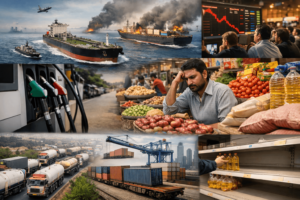
When conflict disrupted this corridor in early 2026, the impact on logistics was immediate and severe.
Shipping through the region became increasingly complex due to:
- A sharp decline in vessel movement
- Withdrawal of insurance coverage by major P&I clubs
- War risk premiums rising dramatically
- Reduced vessel availability and increased freight costs
For freight forwarders and carriers, this translated into operational uncertainty, rising costs, and disrupted schedules.
The Yuan Condition: A Turning Point in Global Trade Finance
Iran’s proposal to allow passage only for yuan-denominated oil shipments introduces a new dimension to global logistics.
This is not merely a currency switch—it is a structural shift in how trade could be conducted at one of the world’s most critical chokepoints.
If adopted, it could lead to:
- Dual pricing systems for oil (USD vs Yuan)
- Increased demand for alternative payment systems
- Reduced reliance on traditional Western financial infrastructure
For logistics companies, this raises critical questions:
- How will freight contracts be priced in multi-currency environments?
- What happens to exchange rate risks in long-term shipping agreements?
- How will payment settlements evolve across regions?
The Hidden Infrastructure Behind the Shift
What makes this development particularly significant is that the financial infrastructure supporting it is already in place.
China has spent years building alternatives to dollar-based systems, including:
- CIPS (Cross-Border Interbank Payment System) for yuan settlements
- Oil trading platforms that allow yuan-based transactions
- Digital currency initiatives enabling faster cross-border payments
This means the shift, if it accelerates, will not face the usual barriers of adoption—it is already operational.
For freight forwarding companies, this signals the need to adapt to multi-currency trade ecosystems.
Game Theory in Global Trade: Why Countries May Accept the Shift
From a logistics and trade perspective, the situation creates a classic dilemma.
Every oil-importing country faces a choice:
- Refuse yuan transactions and risk supply disruptions
- Accept yuan and adapt to a new financial system
Individually, the rational decision is to ensure uninterrupted supply. Collectively, this could lead to a gradual shift away from dollar dominance.
The likely outcome is not an abrupt collapse, but a fragmented global trade system, where:
- Western markets continue using USD
- Asian markets increasingly adopt yuan
For global logistics providers, this fragmentation introduces complexity—but also opportunity.
Implications for Freight Forwarding and LCL Consolidation
This evolving scenario has direct and measurable impacts on the logistics industry.
1. Freight Cost Volatility
Currency fluctuations and rising insurance premiums will increase freight costs, especially on energy-dependent routes.
2. Payment and Settlement Complexity
Freight forwarders may need to manage contracts across multiple currencies, increasing financial risk and operational complexity.
3. Route Diversification
Shippers will actively seek alternative trade corridors to reduce dependency on high-risk chokepoints.
4. Demand for Flexible Logistics Solutions
Businesses will increasingly rely on partners who can offer:
- Multi-modal transport options
- Flexible routing strategies
- Consolidation services to optimize costs
5. Increased Importance of LCL Consolidation
In uncertain markets, LCL (Less than Container Load) solutions become critical for:
- Reducing inventory risk
- Maintaining supply chain agility
- Optimizing shipping costs
India’s Position: A Strategic Logistics Challenge
India finds itself at a particularly complex intersection of this shift.
With over 85% dependence on imported crude oil, disruptions in the Gulf directly impact:
- Freight costs
- Currency stability
- Import-export economics
India has already experimented with non-dollar trade mechanisms, which may ease transition—but also introduces new challenges in managing currency exposure.
For Indian importers and exporters, the key priorities will be:
- Diversifying sourcing strategies
- Partnering with experienced freight forwarders
- Leveraging efficient consolidation networks
What This Means for Global Logistics Strategy
The key takeaway for businesses is clear: logistics is no longer just about moving goods—it is deeply intertwined with geopolitics and financial systems.
To stay competitive, companies must:
- Build resilience into supply chains
- Work with logistics partners who understand global risk dynamics
- Adopt flexible, multi-currency trade strategies
Freight forwarders that can combine operational expertise with financial and regulatory insight will emerge as industry leaders.
Conclusion: The Future of Trade Will Be Multi-Dimensional
The events of 2026 may not immediately dismantle the existing global order—but they are accelerating a transformation that has been building for years.
We are moving toward a world where:
- Trade routes are more dynamic
- Currency systems are more fragmented
- Logistics strategies must be more adaptive
For businesses, this is not just a challenge—it is an opportunity to rethink and strengthen their supply chains.
In a rapidly evolving global trade environment, having the right logistics partner is more critical than ever.
Whether it’s navigating geopolitical risks, optimizing freight costs, or managing complex cross-border shipments, expertise makes the difference.👉 Connect with us to build a resilient, future-ready logistics strategy powered by reliable freight forwarding and LCL consolidation solutions.