
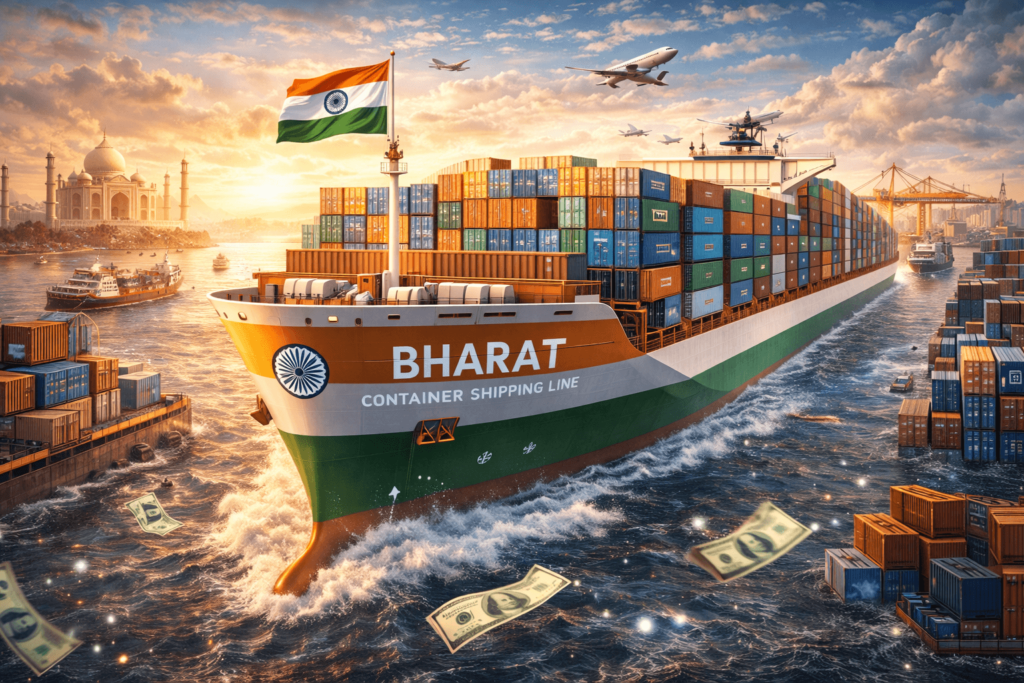
India is entering a historic new phase in its maritime and logistics journey. On October 29, 2025, during India Maritime Week 2025 in Mumbai, Prime Minister Narendra Modi announced the launch of the Bharat Container Shipping Line (BCSL)-a national container carrier backed by $6.9 billion in investment.
For an industry where 95% of India’s trade by volume moves through the sea, this marks a turning point not just for shipping lines, but also for freight forwarders, LCL consolidators, exporters, and the wider logistics ecosystem.
With a broader $26 billion maritime modernisation programme and 437 new vessels planned, India is signalling its intent to take control of its maritime future.
India’s Shipping Dependency: The Hidden Cost for Exporters and Freight Forwarders
Despite being one of the world’s largest trading nations, India handles barely 5–10% of its own seaborne cargo on Indian-flagged vessels. The remaining 90–95% is carried by foreign container giants such as Maersk, MSC, and COSCO.
This heavy dependency has several consequences:
- Volatile freight rates during global disruptions
- Container shortages, especially during peak export seasons
- Lack of priority allocation on key routes
- High foreign exchange outflow, weakening India’s logistics competitiveness
During global supply chain crises, foreign carriers often divert capacity to their strongest markets-leaving Indian exporters and forwarders struggling.
For freight forwarders, NVOCCs, and LCL consolidators, this unpredictability directly affects sailing schedules, container availability, and overall service reliability.
BCSL’s Strategic Role: A National Carrier Built for Stability and Scale
BCSL launches with 51 boxships, funded by the Maritime Development Fund under a public-private partnership model.
Its strategic objectives include:
- Reducing India’s freight dependence on foreign carriers
- Providing predictable, stable freight rates
- Improving equipment availability for exporters
- Increasing India’s share of shipping revenues
- Carrying 20% of India’s container trade within the next decade
Initially focusing on Asia, West Asia, and the Red Sea, BCSL aims to expand into Europe, Africa, and the Americas.
A Key Boost for LCL Consolidators & Freight Forwarders
Reliable weekly capacity, predictable schedules, and stable pricing will enable:
- Stronger LCL consolidations
- More secure block space agreements
- Lower transit time variability
- Better planning for outbound and inbound consolidation cycles
This is a transformative shift for India’s export-driven sectors like textiles, engineering goods, pharmaceuticals, chemicals, and MSME merchandise.
Learning from Global Success Stories
India’s move parallels the success of national carriers in countries such as:
- China – COSCO became one of the world’s largest shipping companies
- South Korea – HMM’s transformation boosted its manufacturing exports
- UAE – ADNOC’s fleet powers global energy distribution
However, global history also offers caution:
- State-run carriers often struggle without continuous investment
- Fleet modernisation and technology adoption are critical
- Customer service must match global standards
- Poor cost management can erode competitiveness
BCSL’s long-term success will depend on whether it remains commercially-driven, technology-led, and globally benchmarked.
Short-Term and Long-Term Impact on Indian Logistics
✅ Short-Term Benefits for Exporters & Forwarders
- More predictable freight rates
- Improved availability of containers
- Reduced transshipment dependency
- Better control over routing schedules
🌍 Long-Term Benefits
If BCSL captures even 10–15% of market share, India could retain $2–3 billion annually in freight earnings-capital that can be reinvested into logistics, infrastructure, and skill development.
This supports India’s larger goals:
- $2 trillion export target by 2030
- Becoming a top 5 shipbuilding nation under Maritime India Vision 2047
- Creating high-value jobs in ports, shipping, and logistics
For freight forwarders and LCL specialists, a stronger maritime backbone means more opportunities, higher volumes, and smoother export cycles.
What Challenges Lie Ahead for BCSL?
BCSL will compete against global shipping giants that possess:
- Massive economies of scale
- Advanced digital platforms
- Global port alliances and networks
- Seasoned fleet management capabilities
To succeed, India must simultaneously:
- Modernise major ports (e.g., Vadhavan, Vizhinjam)
- Strengthen hinterland connectivity
- Digitise customs and port processes
- Ensure seamless coordination between ports, terminals, and BCSL sailings
A national carrier alone cannot transform the ecosystem-it must be supported by world-class infrastructure.
India’s New Maritime Era: A Game-Changer for the Logistics Industry
The launch of Bharat Container Shipping Line represents far more than a new shipping company. It marks a strategic shift toward maritime self-reliance, with direct benefits for India’s exporters, freight forwarders, and consolidators.
If implemented effectively, BCSL can:
- Lower logistics costs
- Improve supply chain reliability
- Strengthen India’s competitiveness
- Reduce FX outflow
- Transform India into a preferred global trade partner
For the freight forwarding and LCL consolidation community, this is the beginning of a new era-one that promises stability, growth, and access to predictable maritime capacity.