
India-Russia Trade Boost in 2025: Can Russia Rescue India’s Export Dreams?
The New Trade Realignment Amid US Tariff Pressures
India’s manufacturing and export sectors face unprecedented challenges following recent US tariff hikes, which have led to stalled orders and disrupted supply chains. In this context, Russia emerges as a strategic partner, offering promising trade assurances and a vital alternative market for Indian exports.
The Growing India-Russia Trade Relationship
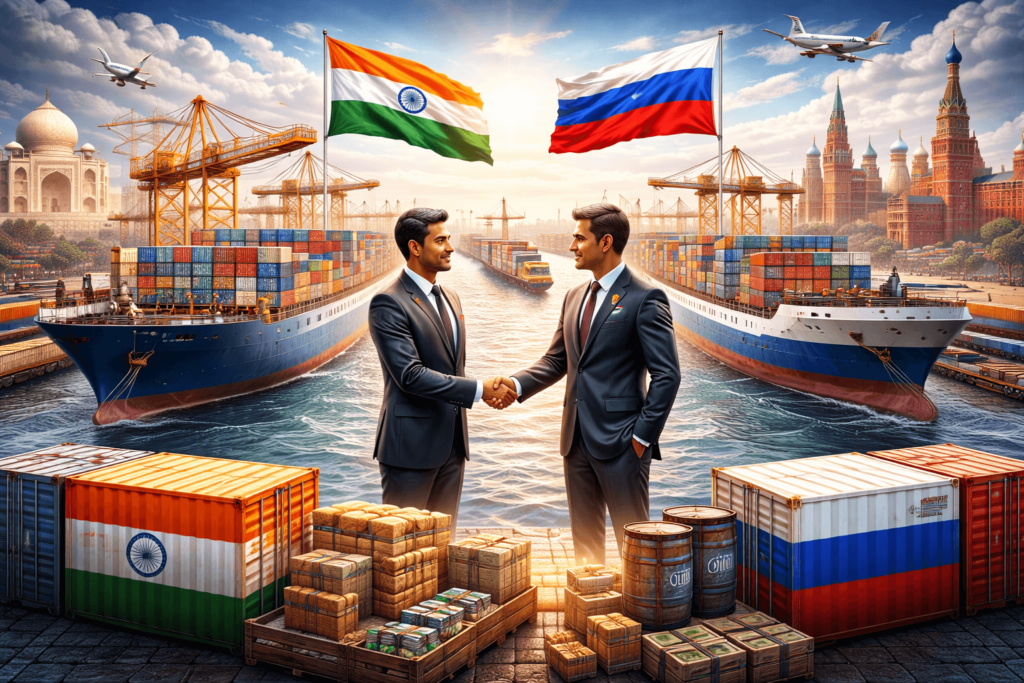
In late 2025, Russian President Vladimir Putin assured Indian officials that Moscow plans to increase imports of Indian goods to address bilateral trade imbalances. This development comes at a time when US sanctions and higher tariffs are prompting Indian exporters to diversify markets beyond traditional Western buyers.
The India-Russia bilateral trade volume peaked at a record $68.7 billion in FY 2024-25, a nearly sixfold increase compared to pre-pandemic levels of $10.1 billion in 2019-20. India’s exports to Russia stood at $4.9 billion, signaling promising growth, although still modest relative to Russia’s imports of around $63.8 billion, predominantly energy supplies.
Historical Context: India-Russia Trade During the Cold War
During the Cold War, India and the USSR forged close economic ties driven by political alliances. The USSR was a major buyer of Indian tea, jute, pharmaceuticals, and engineering goods, providing both markets and technology transfer that helped accelerate India’s industrialization.
These long-standing ties insulated India from global shocks and political pressures, illustrating how geopolitical alignments can deeply influence trade flows—a pattern that may be repeating in today’s shifting environment.
Parallels With Past and Current Global Trade Shifts
History shows that diversification of export markets often occurs during geopolitical tensions:
- The early 2010s saw companies adopt the China+1 strategy, shifting manufacturing to Vietnam, Indonesia, and Bangladesh.
- During the 1980s, Japanese export restrictions prompted “flying geese” shifts, with emerging hubs across South Korea, Taiwan, and Southeast Asia.
Today, India faces a similar turning point. Strengthening trade with Russia could partly offset US tariff losses, but structural issues like payment systems, customs barriers, and logistics need resolution for this potential to be fully realized.
Challenges and Opportunities in India-Russia Trade
While Russia offers a promising alternative, Indian exporters face hurdles:
- Complex import regulations and certification requirements
- Customs clearance delays
- Freight and logistics bottlenecks
However, ongoing negotiations for Free Trade Agreements (FTAs) between India and the Eurasian Economic Union—comprising Russia—aim to reduce tariffs and streamline market access for sectors like:
- Agriculture
- Pharmaceuticals
- Textiles
- Engineering goods
Strategic collaborations and infrastructural investments can unlock significant growth opportunities here, provided these barriers are addressed.
Future Outlook: A Diversified, Resilient Export Strategy
India’s export trajectory will likely encompass a balance—maintaining strong US market links while aggressively expanding into Russia, the EU, ASEAN, and Africa. Russia’s support offers a directional hedge against US tariffs but only as part of an overall diversified portfolio.
Success will depend on:
- Addressing non-tariff barriers
- Improving logistics and supply chain efficiency
- Harmonizing regulations across partner countries
- Leveraging geopolitical partnerships prudently
The India-Russia alliance could be a game-changer if approached strategically, helping Indian industries remain resilient amidst global trade disruptions.
Final Thoughts
The evolving India-Russia trade relationship holds immense potential to reshape India’s export landscape in 2025 and beyond. By embracing diversification, technological upgrades, and geopolitical negotiations, India can turn this opportunity into a long-term competitive advantage.