
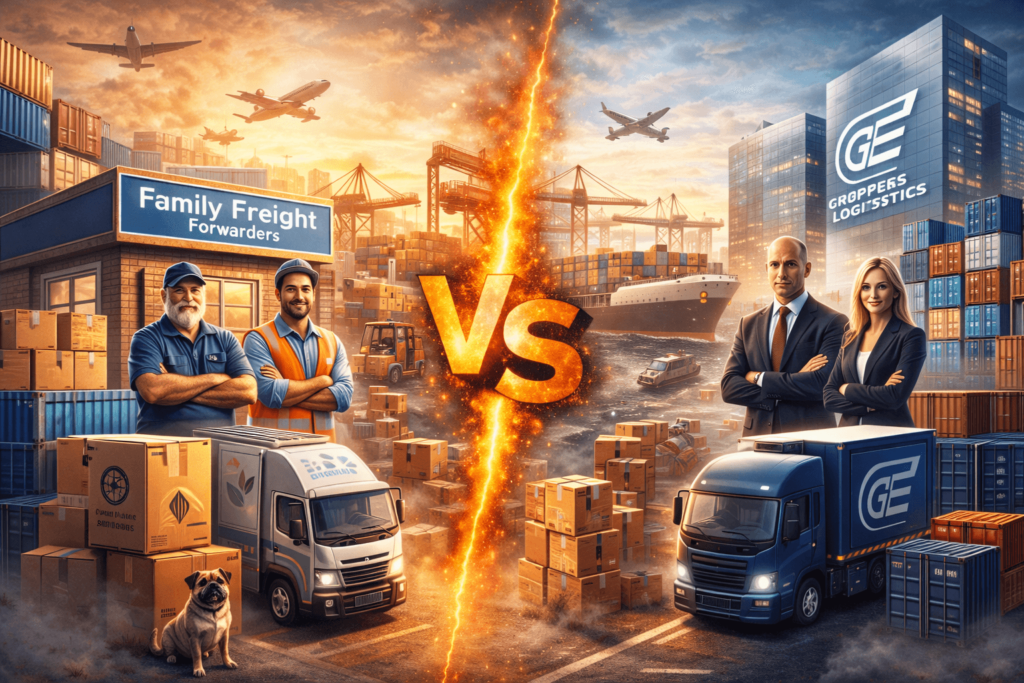
Family Freight Forwarders vs. Global Giants: A Battle of Survival
Family-owned freight forwarding businesses have long been the backbone of global logistics, especially in emerging markets like India. Yet today, global giants like Kuehne + Nagel, DHL, and Sinotrans dominate with sprawling networks and digital firepower. So how do these smaller, legacy players survive—and even thrive—in a market controlled by multinational corporations?
We’ll try and find the answer in this blog.
Strength of Family-Owned Freight Forwarders
Family freight forwarders are deeply rooted in their regions, offering personalized service, long-term client relationships, and niche expertise that multinational giants often overlook. Globally, family businesses generate over 60% of GDP and 78% of jobs in many economies, highlighting their economic importance.
In India, many family-owned forwarders have decades of experience, agile decision-making, and a loyal customer base in niche segments like less-than-container loads (LCL) or regional exports. Their personal touch and local knowledge provide resilience against market shocks and regulatory complexities.
The Rising Tide of Global Giants
The freight forwarding industry is rapidly consolidating. In 2025, Sinotrans Ltd. (China) ranked the largest global ocean freight forwarder with nearly 4.9 million TEUs handled, followed by Switzerland’s Kuehne + Nagel and Germany’s DHL. These giants leverage digital platforms, scale economies, global carrier contracts, and end-to-end services, winning large multinational clients.
Their investments in AI, blockchain, and real-time visibility create seamless shipping experiences often beyond the technology budgets of smaller family firms.
What’s Happening in Other Countries?
In countries like New Zealand, family-driven forwarders like Mondiale remain market leaders by innovating while retaining core values, competing successfully through specialization and customer intimacy. European family businesses leverage regional dominance and build partnerships with global carriers for cross-border reach, balancing tradition and modernization—a model increasingly seen in India’s evolving logistics ecosystem.
Survival Strategies for Family Forwarders
Family-owned forwarders face challenges including limited capital for technology investment, talent shortages, and scaling pressures without sacrificing service quality. A 2024 study showed about 70% of family businesses fail or get sold before the second generation, underscoring succession risks.
To survive and compete, family firms must:
- Embrace digital freight platforms and SaaS tools to streamline operations and improve transparency.
- Build niche expertise in complex regulatory or perishable cargo.
- Form alliances or regional networks to achieve collective scale.
- Upgrade skills and governance for professional management.
Impact on Local and Global Economy
Family-owned forwarders play a vital role in providing employment and enabling MSME exporters in developing countries like India. Their survival supports economic diversity, prevents monopolies, and preserves competitive pricing.
Global giants improve efficiency, expand service offerings, and invest heavily in sustainability, raising overall industry standards. Balancing these dynamics will shape the future logistics landscape. Supportive policies, financial inclusion, and access to technology will determine family firms’ health in the digital age.
The Future of Freight Forwarding—Coexistence and Collaboration
The narrative is not family firms versus global giants but how both coexist and complement each other. Indian family freight forwarders who innovate while preserving client-centric values can remain invaluable regional players.
Meanwhile, partnerships with global players provide scale and digital access. This competition and collaboration improve service standards benefiting the wider supply chain and economy.