
As 2025 wraps up, the global and Indian shipping and logistics industry has delivered some truly impressive numbers. Strong port performance, infrastructure upgrades, and growing demand for LCL services have created significant momentum. For freight forwarders and LCL consolidators, these developments signal opportunity, stability, and a promising horizon.
📈 2025 at a Glance: India’s Logistics Breakthroughs
Major Ports Post Record Volumes
- In FY 2024-25, India’s major ports collectively handled ~855 million tonnes of cargo — up from 819 million tonnes in FY 2023-24, a 4.3% year-on-year increase. (DD News)
- Containerized cargo contributed significantly: container traffic rose ~10%, fertilizers by 13%, and “other commodities” by 31%. (The Economic Times)
Top Ports Break New Ground
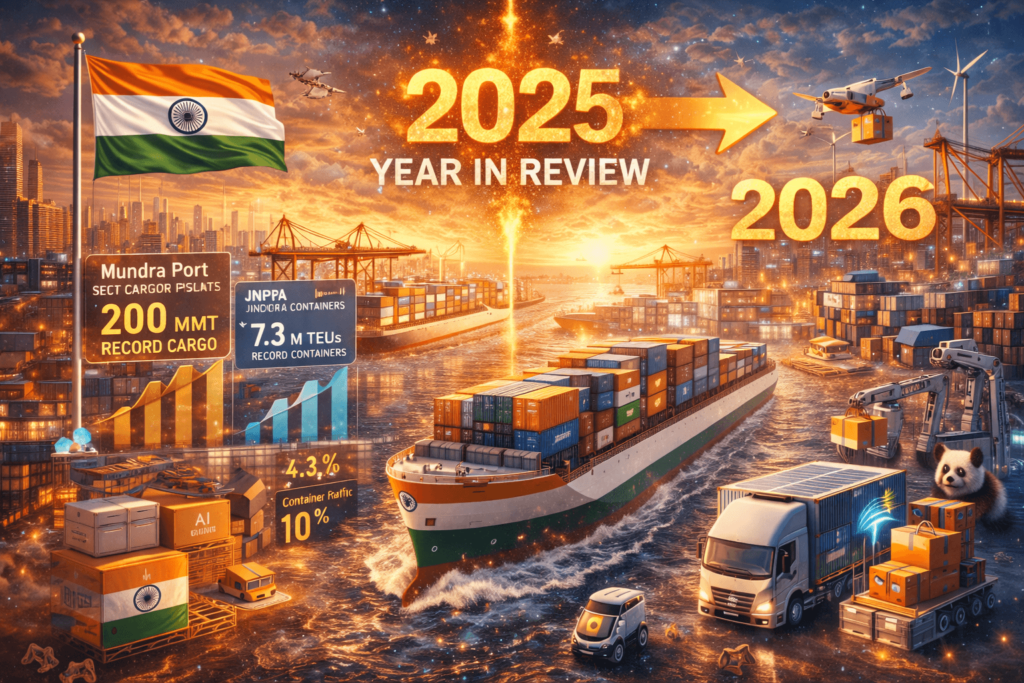
- Mundra Port became the first Indian port to handle over 200 million metric tonnes (MMT) of cargo in a single year (FY 2024-25). (The Economic Times)
- Meanwhile, Jawaharlal Nehru Port Authority (JNPA) logged a record 7.3 million TEUs in FY 2024-25 — illustrating strong container throughput growth and robust system capacity. (logisticsoutlook.com)
Efficiency & Infrastructure Gains Reflecting Modernisation
- Over the past decade, cargo volumes at major ports climbed from ~581 million tonnes in 2014-15 to ~855 million tonnes in 2024-25 — roughly CAGR of 4%. (World Ports)
- This reflects not just volume growth, but improved port infrastructure, faster turnaround, and capacity scaling to meet rising trade demands. (World Ports)
Rise in Demand for LCL / Consolidation Services
With rising container traffic and increased cargo from small and medium exporters, demand for flexible, cost-effective solutions like Less-than-Container Load (LCL) consolidation surged. As ports and terminals become more efficient, LCL consolidators are better positioned to offer competitive transit times and cost advantage for MSMEs looking to tap global markets.
🌍 Global Shipping & Logistics Trends That Impact 2026
- Adoption of advanced technologies — including automation, smart-port systems, and AI/IoT-based logistics — is gaining traction globally, enabling higher throughput, reduced idle time, and improved supply-chain visibility. (arXiv)
- Growing emphasis on sustainability and “green” shipping operations (fuel efficiency, energy management at ports, emissions reduction) is shaping carrier and port investments — a trend likely to define 2026 operations. (arXiv)
- Global supply-chain players are increasingly offering flexible models (LCL, multimodal consolidation, intermodal rail-sea solutions) to accommodate shifting trade flows and smaller shipment volumes.
🔭 What 2026 Could Bring — Predictions & Opportunities
1. Expansion of LCL Networks & Trade Lanes
- Expect more direct LCL consolidation routes from India to Southeast Asia, Europe, North America, Africa — enabling faster, cost-efficient access for MSMEs.
- Smaller exporters may increasingly shift to LCL rather than FCL, benefiting from improved port capacities and competitive freight rates.
2. Digital & Paperless Shipping Gains Speed
- Wider adoption of digital documentation, e-bills of lading (eBL), AI-driven customs clearance, and real-time tracking — cutting documentation time and improving transparency.
- Logistics providers and freight forwarders investing in tech will benefit from reduced clearance delays and lower administrative overhead.
3. Sustainability & Green Shipping Becomes Mainstream
- Ports and carriers likely to invest more in low-emission fuels, energy-efficient port equipment, and carbon-reduction solutions — appealing to eco-conscious global buyers.
- Sustainable practices could become a differentiator for service providers, influencing global shipping contracts and supply-chain sourcing decisions.
4. Increased Port-Led Industrial & Inland Connectivity
- With expandable port capacities and improved hinterland connectivity (rail & road), expect logistics services to integrate more multimodal solutions — offering end-to-end supply chain coverage.
- Faster coastal shipping, inland container depots, and rail-sea consolidation could emerge as growth segments.
5. Growth of Export-Oriented SMEs via Consolidators & Forwarders
- With improved infrastructure and flexible LCL services, more small and medium exporters may enter global trade — driving demand for consolidation, freight forwarding, and value-added logistics services.
- Freight forwarders should prepare to offer bundled services: consolidation, warehousing, customs support, and last-mile delivery to offer a one-stop solution.
✅ Why This Matters for Forwarders and LCL Consolidators
For freight forwarding companies and LCL consolidators, 2025’s growth and 2026’s potential translate into:
- Higher volume throughput at lower marginal cost — making LCL consolidation increasingly viable and profitable
- Opportunity to attract MSME exporters who were previously unable to meet FCL minimums or afford high freight costs
- A role as strategic partners in global supply chains, offering reliability, flexibility, and visibility
- Chance to differentiate services via sustainability, digital efficiency, and end-to-end logistics support
As we close 2025, the trajectory is clear: stronger infrastructure, higher efficiency, rising trade volumes, and expanding opportunities for consolidation and value-added logistics services.
Here’s to 2026 — a year of innovation, growth, and global opportunities.
Wishing you and your team a very Happy New Year! 🎉